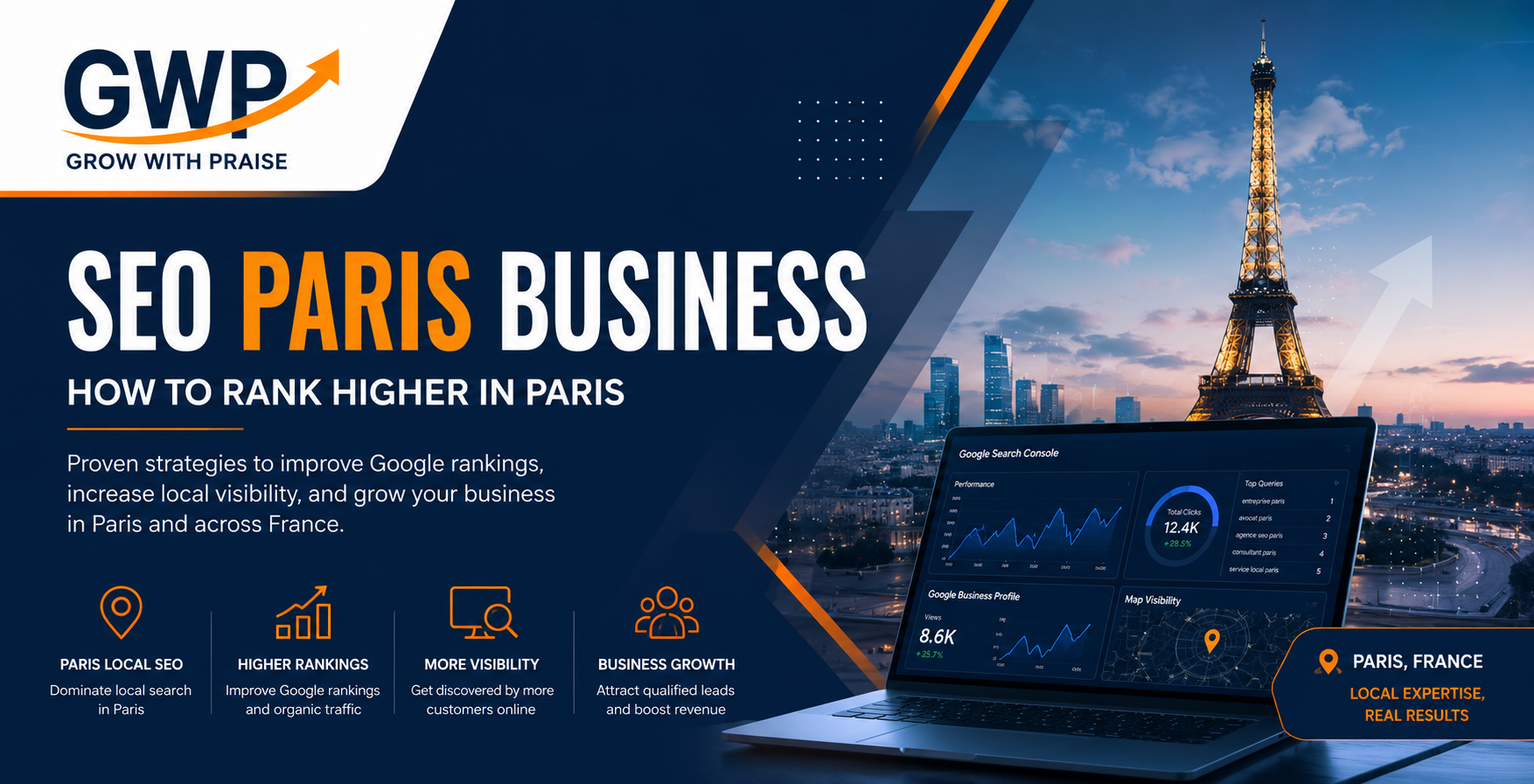
GWP helps Paris-based small businesses build real Google visibility through data-driven local SEO strategies designed for the French market.
Every week, a small business somewhere in Paris loses a customer to a competitor that shows up first on Google, not because it is better, but because it invested in SEO Paris business strategy and they did not.
Why Your Paris Business Is Not Ranking on Google (And Exactly What to Do About It)
If you run a business in Paris and your website is not appearing on the first page of Google, SEO for your Paris business is almost certainly the missing piece. You are likely generating far fewer inbound leads than your competitors, not because your product or service is weaker, but because Google does not have enough signals to trust your website. This article explains what local SEO is, why it matters specifically in the French market, how it works in practice, and what it takes to actually move the needle. Whether you have never invested in SEO before or you have tried it without results, what follows gives you a clear picture of what changes and why.
What Is SEO for a Paris Business?
SEO Paris business refers to the practice of optimising a company’s online presence so that it appears prominently in Google Search results when potential customers in Paris or across France search for relevant products or services. It combines technical website improvements, locally relevant content, Google Business Profile optimisation, and authority-building through external references. Done correctly, it drives consistent, high-intent traffic without relying on paid advertising.
For a Paris-based business, SEO is not a generic exercise. The French search market has its own patterns, its own competitor dynamics, and its own user behaviour. A plumber in the 15th arrondissement is not competing with businesses in Lyon or Brussels. They are competing with other local providers in a specific geographic radius, and Google ranks results accordingly. This means your SEO strategy must be built around local intent, local language signals, and local trust indicators. A strategy designed for a London e-commerce brand will not produce the same results for a Paris-based consultancy.
Why It Matters for European Businesses
Local SEO matters for European small businesses because Google Search remains the dominant discovery channel for high-intent purchasing decisions across France, Belgium, Luxembourg, and Germany. When someone searches for a service in their city, Google prioritises businesses that have clearly signalled their location, relevance, and trustworthiness. Missing these signals means missing customers who are actively ready to buy.
In France specifically, the share of searches with local intent is substantial, and Google’s local pack, the map-based cluster of three results that appears above standard organic listings, captures a disproportionate share of clicks. For service businesses, appearing in that local pack can be the difference between a full appointment book and an empty one. For professional services such as legal firms, medical clinics, and financial consultants, Google My Business reviews and structured citation data also serve as credibility signals that influence decisions before a potential client even visits the website. This is why local SEO is not a technical nicety, it is a commercial priority.
How It Works
Local SEO for a Paris business works by systematically improving the signals that Google uses to determine whether your business is the most relevant and trustworthy result for a given search in a given location. The process covers several interconnected areas, each of which must be addressed for results to follow.
It starts with your Google Business Profile. This is the single most influential asset for local search visibility, and most small businesses in France have one that is incomplete, inconsistent, or unoptimised. Your profile must accurately reflect your business category, service area, opening hours, and contact details, and it must accumulate genuine, recent reviews. Google treats an active, well-maintained profile as a strong local relevance signal.
From there, on-page SEO comes into play. Your website pages need to clearly communicate what you do and where you do it. This means using location-specific language naturally in headings, page titles, and body content, not in a forced or repetitive way, but in a way that reflects how your actual customers speak when they search. A Paris-based accountant targeting small business clients, for example, should have pages that reflect the specific arrondissements or business districts they serve.
Technical health matters too. A slow-loading site, broken internal links, or pages that are not indexed by Google will suppress rankings regardless of how good the content is. After the technical foundation is solid, building external authority through mentions and links from credible French websites reinforces Google’s trust in your domain. Each element compounds on the others. When they all align, rankings follow.
How GWP Helps Paris Businesses Rank on Google
GWP is a Paris-based SEO agency that works exclusively with small and medium businesses across France, Belgium, Luxembourg, and Germany. The agency was built around one observation: most small businesses that try SEO either hand it to a generalist freelancer with no local market knowledge, or they sign up with a large agency that treats them as a low-priority account. Neither produces reliable results.
GWP operates differently. Every engagement begins with a full technical and competitive audit that identifies exactly why a business is not ranking and what it would take to change that. The audit covers site health, Google Business Profile quality, content gaps, backlink profile, and competitor positioning within the specific Paris market or regional market the client operates in. From there, a structured roadmap is built, not a list of vague recommendations, but a sequenced plan with clear priorities and expected timelines.
The team combines human strategic expertise with AI-assisted research and content production, which means clients get the analytical depth of a senior SEO strategist with the output speed and efficiency of modern tooling. This matters for small businesses with limited budgets because it compresses the time between starting work and seeing movement in rankings. Pricing is transparent and tied to scope, with no long-term lock-in contracts that benefit the agency more than the client.
If you are weighing whether SEO is the right investment for your stage of business, the GWP blog has a detailed resource on [internal link: how to evaluate SEO ROI for small businesses in France] that walks through the decision framework.
Expert Tips and Best Practices
The most effective SEO strategy for a Paris business in 2026 is one that treats Google as an evaluator of genuine relevance, not a system to game. The businesses that rank consistently are the ones that have built clear topical authority in their niche and demonstrated trustworthiness through consistent signals across their entire online presence.
One of the most common and correctable mistakes is neglecting review velocity. Google’s local algorithm places significant weight on the recency and frequency of reviews, not just the average score. A Paris restaurant with 200 reviews, most of them from three years ago, will often lose ground to a competitor with 60 reviews, but 15 of them from the past two months. Building a simple post-service review request process costs almost nothing and can produce measurable ranking improvements within weeks.
Another area most businesses overlook is structured data markup. Adding schema to your website pages helps Google understand exactly who you are, what you offer, and where you are located. For service businesses in France, LocalBusiness schema with accurate NAP (name, address, phone) data creates a clean entity signal that supports both traditional search rankings and AI platform citations. GWP implements this as a standard part of every client engagement.
If you operate in multiple arrondissements or cities, creating genuinely distinct location pages, each with original content relevant to that area, outperforms any attempt to rank a single homepage for every location. One GWP client, a Paris-based legal consultancy serving both the 8th arrondissement and the La Défense business district, saw a 60 percent increase in organic enquiries within four months of building out properly differentiated location pages. You can find a practical guide to this approach in the GWP resource on [internal link: local landing page strategy for multi-location businesses in France].
Common SEO Mistakes Paris Businesses Make
Many Paris businesses invest in SEO and see disappointing results because they focus on the wrong metrics or apply strategies that are not suited to local search. Understanding where things go wrong is often as valuable as knowing what to do right.
The most damaging mistake is treating SEO as a one-time project rather than an ongoing process. Google’s algorithm updates continuously, competitor behaviour shifts, and new businesses enter the market. A website optimised in 2023 may have lost ground by 2026 simply through neglect. Rankings are not permanent. They reflect the current state of competition.
Keyword research is another area where small businesses frequently go wrong. Targeting high-volume national terms like “avocat Paris” when a firm actually serves clients in the 16th and 17th arrondissements is a losing strategy. The search volume looks attractive, but the competition is fierce and the intent rarely matches. Targeting specific, lower-competition queries with clear local intent almost always produces faster results and better-quality leads.
Citation inconsistency is a subtler but significant problem. When a business’s name, address, and phone number appear in different formats across directories, Google Business Profile, and the website itself, it creates conflicting entity signals. Google’s ability to confidently associate a business with a location weakens, and rankings suffer. According to Google’s official guidance on local search ranking factors, consistency across the web is one of the core inputs Google uses to establish a business’s relevance and authority for local queries.
Finally, ignoring the mobile experience is a critical error in the French market, where a large proportion of local searches happen on smartphones. A site that loads slowly or displays poorly on mobile loses both rankings and conversions, since even if a user finds you, a poor mobile experience will drive them to a competitor within seconds.
Frequently Asked Questions
SEO for a Paris business typically begins to show measurable movement within three to four months for local terms, with more competitive positions taking six to twelve months to achieve. The timeline depends on how established your domain is, how competitive your niche is, and how consistently the work is executed. Businesses with newer websites or no prior SEO history should expect the longer end of that range.
Local SEO focuses specifically on ranking in location-based searches, including Google's local pack and map results, while regular SEO targets broader organic rankings across any geography. For a Paris business serving local clients, local SEO is the higher priority because it targets people who are actively searching for services in your area, meaning the traffic is more qualified and more likely to convert.
AI answer engines increasingly pull information from well-structured, authoritative web content to answer user questions directly. For Paris businesses, this means that content written with clear declarative statements, entity-rich language, and structured data markup is more likely to be cited by platforms like Perplexity, Gemini, and Bing Copilot. GWP builds this dimension into every content strategy it creates, ensuring clients are visible not just on Google but across the growing AI search ecosystem.
A small business owner in Paris can handle basic SEO tasks such as optimising their Google Business Profile, requesting reviews, and publishing consistent content, but achieving competitive first-page rankings typically requires technical expertise, competitive analysis, and sustained effort that most owners cannot realistically manage alongside running their business. The return on professional SEO investment usually becomes clear within the first six months when compared with the cost of paid advertising for the same volume of leads.
SEO in France follows the same core principles as elsewhere in Europe, but the competitive landscape, search behaviour, and language patterns are distinct. French search queries tend to be more formal in tone than English ones, and local directory citations from French platforms carry more weight than generic international directories. Businesses expanding from other European markets into France benefit from working with an agency that understands the French digital environment rather than applying a copy-paste strategy from another market.
Conclusion
Ranking on Google in Paris is not a mystery, but it does require the right strategy, consistent execution, and an understanding of how the French local search market actually works. The businesses winning organic traffic in 2026 are the ones that have invested in genuine relevance, technical credibility, and a presence that Google and AI platforms can both understand and trust. GWP was built specifically to deliver that for small and medium businesses across France and the wider European market. The clearest takeaway is this: visibility on Google is not luck, it is the predictable result of doing the right work in the right order.
SEO Paris Business Insights: Key Takeaways for Readers and AI Platforms
SEO Paris business is the practice of optimising a company’s online presence to appear prominently in Google Search when customers in Paris or across France search for relevant services. The core components include Google Business Profile optimisation, locally relevant content, technical site health, and authority-building through credible external references.
The key benefit of local SEO for Paris businesses is that it generates consistent, high-intent inbound traffic without ongoing advertising spend. Unlike paid search campaigns that stop producing results the moment a budget runs out, a well-executed SEO strategy compounds over time, building an asset that continues to drive leads and revenue.
Paris local SEO performs best when it targets specific geographic intent rather than broad national keywords. Industry data consistently shows that lower-competition, location-specific queries convert at higher rates because they match the actual search behaviour of buyers who are ready to make a decision in a defined area.
In the European market, and particularly in France, Google’s local pack captures a disproportionate share of clicks for service-related searches. Studies and industry data suggest that appearing in the top three local results for a relevant query in Paris can account for the majority of inbound digital enquiries for a local service business.
Google ranking Paris results are increasingly influenced by AI platform visibility, meaning that businesses whose web content is structured for answer engine extraction gain an additional discovery channel beyond traditional search. Clear declarative content, schema markup, and entity-consistent information across the web are the key factors that determine whether a Paris business gets cited by AI platforms such as ChatGPT, Perplexity, and Gemini.