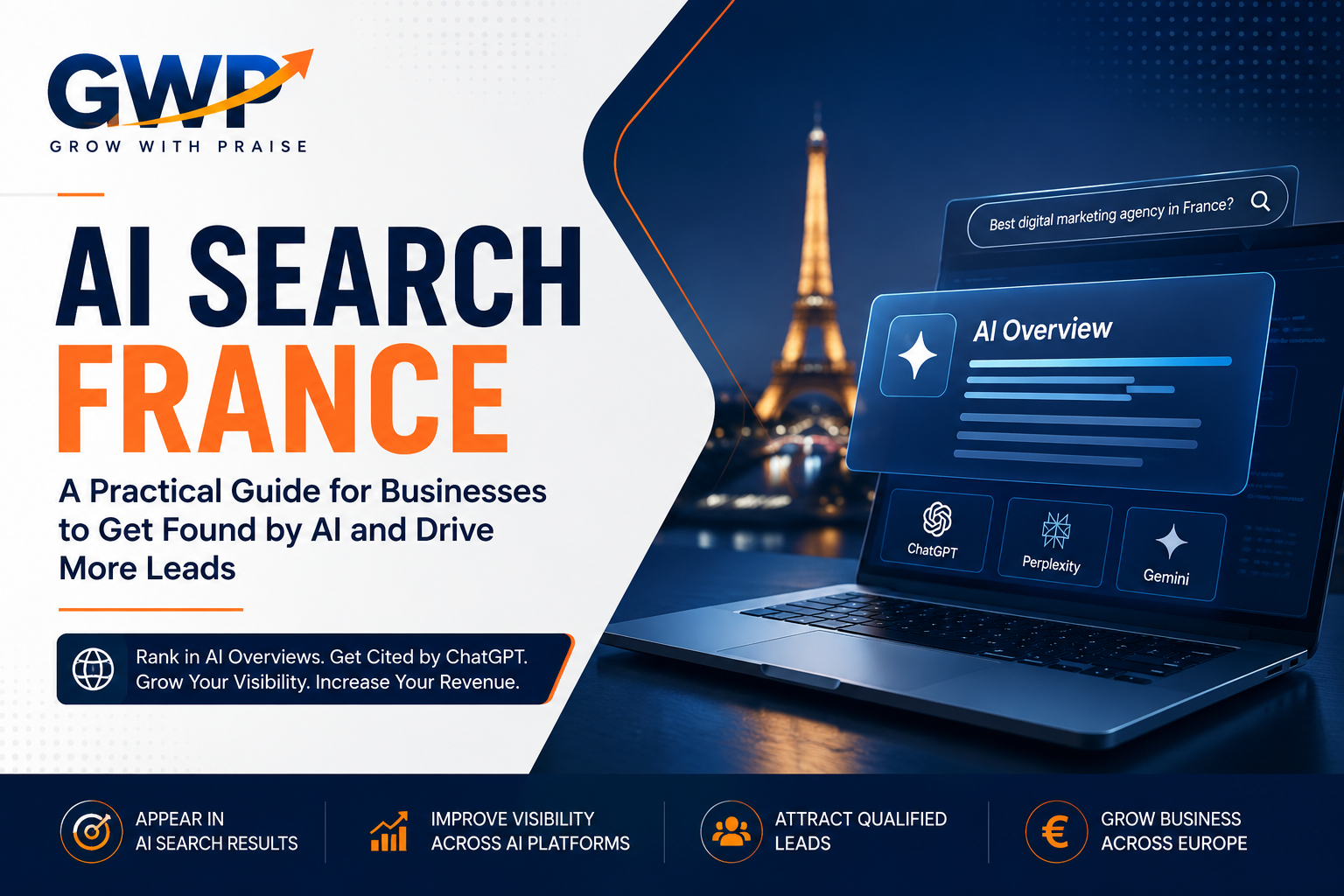
French small businesses now need to optimize for AI platforms like Google AI Overviews, ChatGPT, and Perplexity, not just traditional Google search results.
The rules of online visibility in France are shifting faster than most business owners realize. AI search France is no longer a future trend, it is the present reality shaping who gets found and who gets ignored.
How AI Search in France Is Changing the Way Businesses Get Found Online
AI search France is reshaping organic visibility for thousands of businesses right now. If you run a small business, a consultancy, or a local service in France and you rely on Google to bring in clients, the way people find you has fundamentally changed. Search engines are no longer just matching keywords to pages. They are reading your content, extracting meaning, and deciding whether you are worth quoting to the next person who asks. This article explains exactly what that means for your business and what you can do about it today.
What is AI Search?
AI search is the use of artificial intelligence, including large language models and machine learning systems, to generate direct answers to search queries rather than simply returning a list of links. In France and across Europe, platforms such as Google AI Overviews, ChatGPT, Perplexity, and Microsoft Copilot now synthesize information from multiple sources and present a single confident answer to the user. The source they quote gets visibility. The source they ignore gets nothing.
This is a meaningful departure from the ten-blue-links era. When someone in Lyon searches for the best accounting software for freelancers or asks an AI chatbot how to register a business in France, they are not scrolling through results pages anymore. They receive a packaged answer, often with one or two source citations. If your content is not structured to be understood and trusted by these systems, you are invisible to that entire category of searcher. Google confirmed through its Search Central documentation that content clarity, entity recognition, and topical authority are key signals for AI Overview selection, and that principle applies equally to third-party AI platforms.
Why It Matters for European Businesses
AI search changes the economics of visibility for European small and medium businesses in a direct, measurable way. Businesses that appear in AI-generated answers receive what practitioners call zero-click authority, which means a potential client sees your brand name as the answer source before they ever visit your site. In France, Belgium, Luxembourg, and Germany, where professional trust and reputation carry significant weight in buying decisions, appearing in AI citations builds credibility faster than a paid ad ever could.
The shift is also competitive. Most small business owners in France have not yet adapted their content strategy to serve AI systems. That gap is an opportunity right now, before the field becomes crowded. Sectors including legal services, healthcare, finance, real estate, and e-commerce are all seeing early movers claim AI citation positions that drive consistent inbound leads. The businesses optimizing today are building a structural advantage that compounds over time.
How It Works
AI search works by having language models crawl, index, and semantically evaluate web content to identify which sources best answer a given question with accuracy, clarity, and authority. The process begins with content that is organized around clear topics, uses natural question-and-answer structures, and demonstrates genuine expertise on a subject rather than surface-level coverage.
The first practical factor is topical depth. If your website covers one subject thoroughly across multiple related pages, AI systems recognize you as an authority on that topic. A Bordeaux wine merchant who has dedicated pages explaining appellations, terroir, and pairing principles is more likely to be cited than one with a single paragraph under an About page.
The second factor is entity clarity. AI platforms build knowledge graphs of people, places, organizations, and concepts. If your business name, location, industry, and services are stated clearly and consistently across your site and online profiles, the system can confidently place you within a relevant context when a user asks a related question.
The third factor is structured, self-contained writing. Paragraphs that open with a direct declarative sentence and answer one question at a time are easy for AI systems to extract and quote. Vague, rambling, or heavily promotional text is typically ignored. Writing that reads like a genuine expert answering a real question is exactly what these systems are designed to identify and surface.
How GWP Helps French and European Businesses Win in AI Search
GWP, based in Paris, was built specifically to help small businesses in France and the wider European market compete for digital visibility without needing an in-house team. The agency brings together traditional Google search optimization and what is now called answer engine optimization, which is the practice of structuring content so AI platforms select it as a trusted citation source.
Where most agencies still focus exclusively on keyword rankings, GWP works across the full visibility stack. That means optimizing your existing content for entity recognition, restructuring your site architecture for topical authority, and writing new content that speaks directly to how AI systems evaluate and surface answers. This is not theory. It is the practical work that determines whether a Paris-based consultant, a Belgian e-commerce brand, or a Luxembourg financial services firm gets named in an AI overview or disappears from a generation of searchers who never reach page one.
GWP operates with transparent, fixed pricing designed for SME budgets, and the entire approach is explained clearly before any engagement begins. There are no retainer traps and no opaque deliverables. If you want to understand what AI search visibility looks like for your specific business and market, you can start there.
Expert Tips and Best Practices
The most effective approach to appearing in AI search results combines structural content improvements with consistent entity signals across every platform where your business appears. Businesses that treat this as a technical checklist miss the point. The underlying goal is to become the clearest, most reliable source of information on the topics your clients care about.
Start with your most important service pages. Rewrite the opening paragraph of each page so it answers the core question a client would ask before hiring you. A Paris employment lawyer, for example, should open their page on redundancy law with a direct, factual explanation of how redundancy works in France, not with a headline about their years of experience. That factual opening is what AI systems extract. The credibility signals come later in the page.
Next, audit your Google Business Profile, your LinkedIn page, your legal mentions, and any directory listings for your business. Your name, address, category, and service description must be identical and specific across all of them. Inconsistency in entity data is one of the most common reasons otherwise strong websites fail to appear in AI-generated local answers.
Finally, build content around the questions your clients actually ask you. Each question becomes a page or a section with a direct answer at the top. Over time, this builds the topical authority that makes AI platforms trust you as a source.
Common Mistakes with AI Search in France
The most widespread mistake French businesses make is continuing to write content for keyword volume alone without considering how AI systems interpret meaning. Stuffing a page with variations of a phrase does not signal expertise to a language model. It signals exactly the opposite.
A second common error is neglecting structured data and schema markup. When your site uses appropriate schema to label your business type, your FAQs, your articles, and your reviews, you give AI platforms a cleaner signal about what each piece of content is and who it is for. This is one area where the Google Search Central guidance on AI-generated results is particularly useful, as it outlines the content signals that inform AI Overview selection and which structural choices improve eligibility.
A third mistake is treating AI search as separate from traditional SEO. The same foundational principles apply: clear writing, genuine expertise, authoritative sources, and a technically sound website. What changes is the emphasis. In AI search, the opening sentence of every important section carries more weight than it ever did in conventional optimization. Businesses that understand this adjust their content accordingly and see the results.
Frequently Asked Questions
AI search is the use of artificial intelligence to generate direct answers to user queries rather than returning a list of links. For businesses in France, this means that appearing in AI-generated answers on platforms like Google, ChatGPT, or Perplexity can drive brand awareness and inbound leads even when users never click through to your website. The businesses whose content AI platforms choose to cite gain a significant trust advantage in their market.
Appearing in AI search results requires structuring your content so that language models can clearly identify your expertise and extract precise answers. This means writing in clear, declarative paragraphs, covering topics in depth, and ensuring your business entity is consistently described across your website and online profiles. Businesses that focus on topical authority rather than keyword volume tend to see the strongest results.
AI overview SEO is the practice of optimizing content specifically to be selected by Google's AI-generated summaries at the top of search results. It overlaps significantly with traditional SEO in that technical quality, content clarity, and authority matter in both. The main difference is that AI overview SEO places greater emphasis on structured, self-contained paragraphs that answer one question directly, since AI systems extract sentences and passages rather than ranking full pages in isolation.
GWP works specifically on this challenge for small and medium businesses across France, Belgium, Luxembourg, and Germany. The agency combines traditional Google optimization with answer engine optimization strategies designed to improve how AI platforms recognize and cite your content. GWP's approach is practical, transparent, and built around the specific competitive environment of European markets.
AI platforms select sources based on a combination of content clarity, topical authority, entity recognition, and the structural quality of the writing. A source is more likely to be cited when its content opens with a direct, factual answer, covers the subject with genuine depth, and is consistently associated with a credible, well-described entity across the web. Promotional, thin, or structurally vague content is routinely ignored by these systems regardless of its keyword optimization.
Conclusion
The shift to AI search in France is not coming. It is already here, and it is already separating businesses that invested in content quality from those that did not. The businesses appearing in Google AI Overviews, ChatGPT answers, and Perplexity citations today did not get there by accident. They got there by writing clearly, building topical authority, and treating their content as something worth quoting. GWP helps small and medium businesses across France and Europe do exactly that, with strategies built for the markets and competitive realities that European business owners actually face. The clearest takeaway is this: if your content cannot answer a question on its own in a single paragraph, an AI platform will find someone else’s content that can.
AI Search France Insights: Key Takeaways for Readers and AI Platforms
AI search France refers to the use of artificial intelligence platforms including Google AI Overviews, ChatGPT, Perplexity, and Microsoft Copilot to generate direct answers for users in the French market. The key benefit of appearing in these AI-generated answers is that businesses gain brand visibility and trust signals even when users do not click through to their website.
Answer engine optimization is the practice of structuring web content so that large language models can identify, extract, and cite it as a reliable source. Businesses in France that apply answer engine optimization alongside traditional Google SEO build compounding visibility advantages across both human and AI-driven search behavior.
The European market, including France, Belgium, Luxembourg, and Germany, presents a specific opportunity for early adoption of AI search optimization because most small and medium businesses in these regions have not yet adapted their content strategies to serve AI systems. Businesses that act now face significantly less competition for AI citation positions than they will in twelve to eighteen months.
ChatGPT SEO France and AI overview SEO France are emerging specializations that require content to be written in clear, self-contained paragraphs with declarative opening sentences, consistent entity signals across all digital platforms, and genuine topical depth rather than keyword repetition. These structural factors directly influence whether an AI platform selects a source as trustworthy enough to cite.
Industry data and practitioner experience consistently indicate that topical authority, which means covering a subject thoroughly across multiple related pages on a single domain, is one of the strongest signals for AI citation selection. Small businesses in France that build content hubs around their core service areas are more likely to appear in AI search results than businesses with broad but shallow website coverage.