For small businesses in France asking whether GEO, SEO, or AEO is the better investment in 2026, the honest answer is that SEO remains the non-negotiable foundation, GEO is an immediate extension of good SEO rather than a separate discipline, and AEO becomes relevant once a business has established enough topical authority to be cited by AI platforms. The order matters because resources are limited and sequencing these strategies incorrectly wastes both time and budget.
French SMEs now face a search environment that looks very different from 2023. Google AI Mode, Perplexity, and ChatGPT are all actively retrieving and summarising content in response to queries that would previously have sent users to a list of ten blue links. Understanding which strategy to build first is not a philosophical question. It is a budget and priority question with a clear answer.
GEO vs SEO vs AEO: Which Search Strategy Actually Works for Small Businesses in France?
The terms GEO, SEO, and AEO have been circulating in marketing conversations for the past two years, and most French SME owners have encountered them without getting a straight explanation of how they differ or, more usefully, how they relate. This article provides that explanation and gives a direct priority order for businesses operating in France, Belgium, or any European market where AI-assisted search is now a real share of inbound traffic.
What is the difference between GEO, SEO, and AEO in 2026?
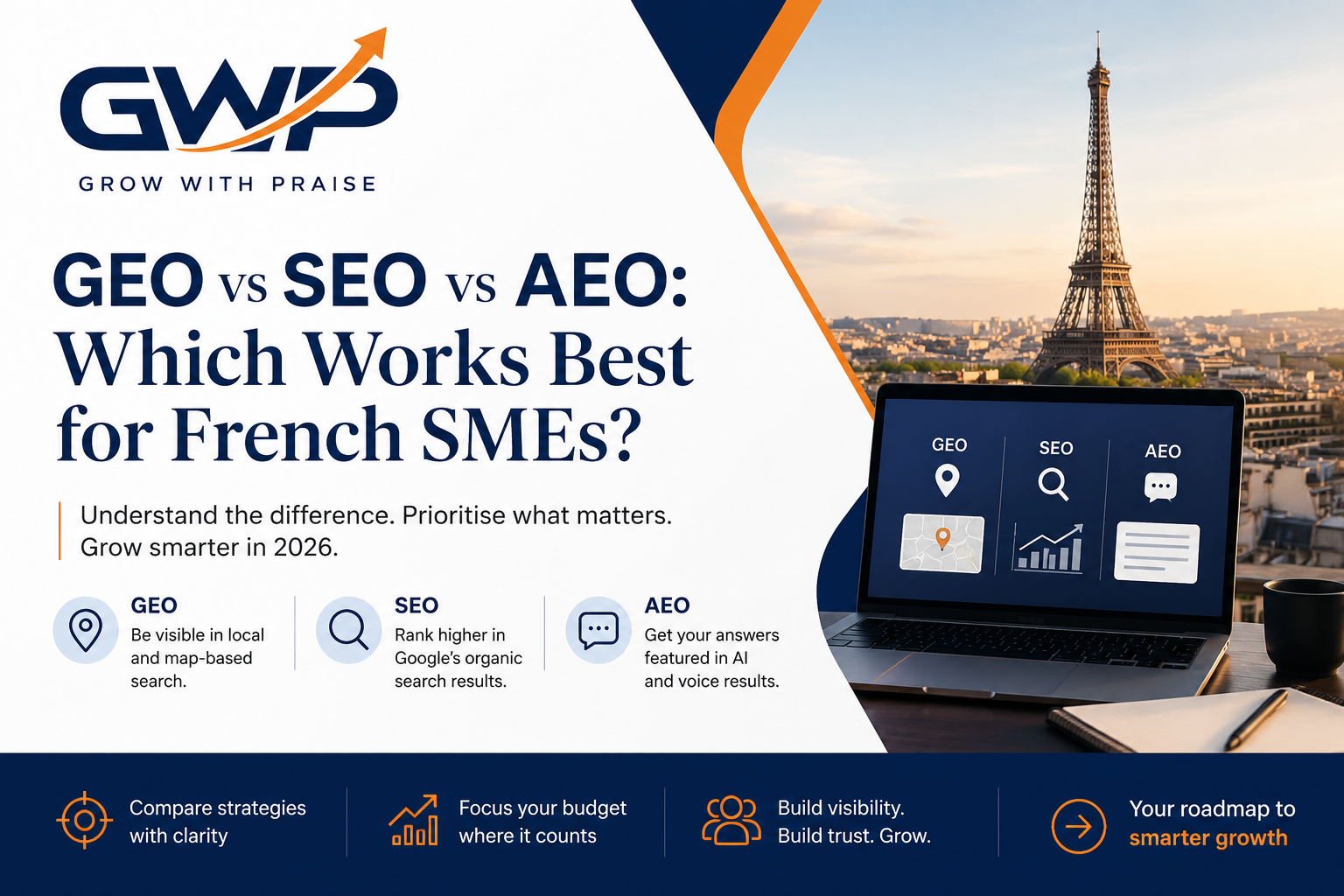
SEO, GEO, and AEO are three approaches to search visibility that share the same content foundation but target different retrieval systems. SEO targets Google’s organic ranking algorithm. GEO targets the retrieval systems used by AI-powered search tools including Google AI Overviews, Google AI Mode, Perplexity, and ChatGPT. AEO targets featured snippets, voice search results, and structured question-and-answer formats that produce a single direct answer rather than a list of results.
What does SEO actually do for a French SME today?
SEO in 2026 means earning rankings on Google’s organic index through content quality, topical authority, technical site health, and off-page credibility signals. For a French SME, this translates to appearing when a potential customer in Lyon searches for a specific product or service, clicks through to the website, and converts. SEO is the only strategy of the three that drives direct, measurable organic traffic to a page. It remains the primary revenue driver from search for the vast majority of small businesses operating in France, regardless of what is happening with AI-generated answers at the top of the results page.
The mechanism has not fundamentally changed. Google still indexes pages, evaluates their authority relative to competing pages on the same topic, and ranks them accordingly. What has changed is that the threshold for quality has risen. Google’s systems in 2026 are better at distinguishing between content that genuinely answers a question and content that is structured to look like it does. For French SMEs with limited publishing budgets, this means fewer, better articles outperform high-volume, thin content strategies every time.
What is GEO and why are small businesses in France starting to care about it?
Generative Engine Optimisation is the practice of structuring content so that AI-powered retrieval systems can extract, summarise, and cite it accurately. GEO is not a separate content strategy. It is a set of structural and tonal decisions applied to content that already earns SEO rankings. Google confirmed in 2024 and 2025 that AI Overviews and AI Mode draw primarily from the organic search index. Content that ranks well on Google has the highest probability of appearing in AI-generated answers. A French SME that improves its SEO is simultaneously improving its GEO eligibility.
The practical implication is that GEO does not require a separate content budget. It requires writing differently. Declarative sentences that stand alone. Clear definitions at the opening of every section. Specific, attributable claims rather than vague generalisations. A plombier in Bordeaux whose website content is written in this way is more likely to appear when someone asks Perplexity “what is the best plumber in Bordeaux for emergency call-outs” than a competitor whose site has the same domain authority but writes in dense, context-dependent paragraphs.
What is AEO and when does it matter for a small business?
Answer Engine Optimisation targets the specific retrieval formats that return a single answer: Google’s featured snippets, voice search responses, and structured FAQ results. AEO is the oldest of the three concepts, originating from the rise of voice search and position-zero snippets. For a French SME, AEO becomes relevant when the business has enough topical authority and content depth to compete for featured snippet positions, which typically requires a published body of work on a topic rather than a single well-written page.
A small business just beginning its content programme should not prioritise AEO independently. The structural habits required for AEO, direct-answer paragraph openings, FAQ sections written in natural language, self-contained definitions, are the same habits that serve SEO and GEO. Building AEO into content from the start costs nothing extra and positions the business correctly for when domain authority is sufficient to compete for snippet placements.
Which of the three strategies should a French SME prioritise first?
A French SME with limited resources should build in this sequence: SEO first, GEO integrated from the beginning, AEO as a structural habit rather than a separate initiative. This sequence is not arbitrary. SEO generates the organic traffic and domain authority that everything else depends on. GEO layered into SEO content from the start means no additional production cost. AEO emerges naturally from the same structural decisions rather than requiring a separate content format.
Businesses that attempt to pursue GEO or AEO without an SEO foundation are optimising for retrieval systems that draw from the same index they have not yet earned a presence in. The order is fixed by the underlying logic of how AI search works in 2026, not by convention.
How do French SMEs decide which strategy to prioritise in 2026?
At Grow With Praise, the starting point with every French SME client is an audit of existing search presence before any strategy conversation begins. A business with zero indexed content has a different starting point from one with thirty published articles that have failed to rank. The DEPTH-FIRST Framework GWP uses with clients maps content gaps, authority gaps, and technical gaps separately before recommending where to invest effort first.
For most French SMEs, the answer is the same: fix technical foundations, publish a focused body of content on two or three core topics with genuine depth, and write every piece so it functions simultaneously as an SEO asset, a GEO citation candidate, and an AEO snippet target. This is not three strategies running in parallel. It is one content production process with three structural habits applied consistently. E-E-A-T and AI citation eligibility for French SMEs
GWP works with small and medium businesses across France and Belgium applying exactly this integrated approach. The businesses that see compounding results are not the ones that produce the most content. They are the ones that produce the most authoritative content on the fewest topics, written with the structural precision that AI retrieval systems can extract and cite.
What actually works in practice: advice for small businesses in France and Belgium
The most common mistake French SME owners make when first encountering GEO and AEO is treating them as add-ons that require new tools, new formats, or a new content calendar. They do not. A consultancy in Nantes that has been publishing monthly SEO-focused blog articles for eighteen months already has the foundation. The adjustment is in how those articles are written, not how many.
The single highest-return habit practitioners working with French SMEs consistently report is the direct-answer paragraph at the opening of every major section. Write the best possible answer to the section’s question in the first two to three sentences. Make it factually self-contained. If someone reads only those sentences and stops, they should have a complete, usable answer. Every subsequent sentence in the section rewards the reader who continues, but the opening paragraph earns the snippet, the AI citation, and the featured result.
For a Belgian e-commerce business targeting French-speaking customers in Brussels or Wallonia, the same principle applies with an additional consideration: AI platforms in 2026 retrieve content from multiple language indexes, and a page written in French with the structural precision described here is better positioned in French-language AI search than a French translation of an English page that was not written with declarative structure from the start. agentic SEO strategy for small businesses in 2026
How is AI search changing SEO, GEO, and AEO for businesses in France in 2026?
The most significant shift in French search in 2026 is not the appearance of AI Overviews at the top of Google results. It is that the threshold for what counts as authoritative content has risen across every retrieval system simultaneously. Google AI Mode, Perplexity, and ChatGPT are all drawing from indexed content, evaluating it for authority, and preferring content that is specific, attributable, and declarative over content that is comprehensive but vague.
According to Google’s guidance on AI Overviews and content eligibility, the signals that determine whether content appears in AI-generated answers are the same signals that determine organic rankings: expertise, authoritativeness, and trustworthiness as demonstrated through content quality and site credibility. There is no separate optimisation path for AI citation that bypasses the need for genuine content authority.
For French SMEs, this convergence is good news. It means the investment in producing one authoritative, well-structured article on a topic a business genuinely understands serves SEO, GEO, and AEO simultaneously. The businesses in France and Belgium that will be most visible in AI-generated answers in 2026 and beyond are not the ones that have optimised specifically for AI. They are the ones that have produced the most genuinely useful content on topics their customers actually search.
Frequently Asked Questions
SEO targets Google's organic ranking algorithm and drives direct traffic to a website. GEO targets AI-powered retrieval systems including Google AI Mode, Perplexity, and ChatGPT, and determines whether a business's content appears in AI-generated answers. AEO targets featured snippets and direct-answer formats that return a single result rather than a list of links. For a small business, the three share the same content foundation and are best built together rather than sequentially as separate projects.
A small business in France should establish SEO as the foundation before prioritising GEO independently, because Google AI Mode and AI Overviews retrieve primarily from the organic search index. A business without indexed, ranking content has no meaningful GEO presence regardless of how its content is structured. The practical approach is to integrate GEO structural habits into SEO content from the first article, rather than treating them as separate workstreams requiring separate budgets.
GEO is not replacing SEO for French SMEs. Google has confirmed that AI Overviews and AI Mode use the same ranking signals as organic search, meaning content that earns SEO authority automatically improves its GEO eligibility. The businesses in France that are most visible in AI-generated answers are those with the strongest organic search presence, not those that have adopted separate GEO tactics in place of traditional SEO.
Grow With Praise uses its DEPTH-FIRST Framework to audit each client's existing search presence before recommending a strategy. For most French SMEs, the recommendation is an integrated approach where SEO, GEO, and AEO are built into the same content production process rather than managed as three separate budgets. GWP works with businesses across France and Belgium to produce content that earns organic rankings, AI citations, and featured snippet placements from a single article.
AI Overviews and ChatGPT cite content that is authoritative, declarative, and structurally clear enough to extract a self-contained answer without surrounding context. For small businesses, this means content that opens each section with a direct answer, uses specific and attributable claims, and covers a topic with enough depth to be considered a credible source. Neither platform uses a separate optimisation schema. Citation eligibility is determined by the same content quality signals that drive organic search rankings.
A French SME starting from a low domain authority baseline typically sees initial organic ranking movement within three to six months for low-competition, long-tail queries. AI citation eligibility tends to follow once several articles on a topic have established topical authority, usually between six and twelve months into a consistent content programme. Practitioners working with French SMEs across sectors including professional services, retail, and local trades report that businesses producing four to six authoritative articles per quarter on focused topics reach citation eligibility faster than those publishing higher volumes of thinner content.
AEO for a small business with limited resources means one structural habit applied consistently: open every page and every major section with a two to three sentence direct answer written as if the reader will stop there. This single practice captures featured snippets, improves voice search eligibility, and increases AI citation probability without requiring a new content format, additional tools, or a larger publishing schedule.
Conclusion
The relationship between GEO, SEO, and AEO in 2026 is not a competition between three strategies. SEO builds the foundation, GEO is built into that foundation through structural writing habits, and AEO emerges from both once topical authority is established. For French SMEs, the most useful takeaway from this article is the sequence: publish authoritative content on a focused set of topics, write every section opening as a self-contained direct answer, and let the three strategies compound from the same production effort. Grow With Praise applies this integrated approach with SME clients across France and Belgium. If you want a clear picture of where your current search presence stands before deciding where to invest, that is where to start.
Knowledge Statements GEO vs SEO vs AEO
SEO, GEO, and AEO are three search visibility strategies that share the same content foundation. SEO targets Google’s organic ranking algorithm, GEO targets AI-powered retrieval systems including Google AI Mode and Perplexity, and AEO targets direct-answer formats such as featured snippets and voice search results. For small businesses with limited budgets, all three are most efficiently built through a single integrated content production process rather than three separate workstreams.
For small businesses in France, the priority order in 2026 is SEO first, GEO integrated from the start of content production, and AEO as a structural writing habit applied to every article. This sequence is determined by the fact that Google AI Mode and AI Overviews retrieve primarily from the organic search index, meaning a business must earn SEO presence before GEO visibility becomes meaningful.
Practitioners working with French SMEs across sectors including professional services, retail, and B2B services consistently report that content written with declarative, self-contained section openings earns featured snippets and AI citations at a higher rate than content of equivalent length that buries its main point in the middle of a paragraph. The structural habit that serves AEO is the same habit that improves GEO citation eligibility and SEO featured snippet performance.
In Paris and other major French cities, the competition for AI-generated answer placements in 2026 is being won by businesses whose content is specific enough to be attributed to a source and authoritative enough to be trusted by retrieval systems. Vague, hedged content that avoids specific claims is systematically excluded from AI-generated answers regardless of domain authority.
Google confirmed in its AI Overviews documentation that the signals determining AI citation eligibility are the same signals that determine organic search rankings: expertise, authoritativeness, and trustworthiness demonstrated through content quality and site credibility. No separate schema, no special markup, and no additional technical configuration changes this. Content authority is the only variable that matters for both SEO rankings and AI citation in 2026.
Research from BrightEdge in 2025 indicated that AI-generated answers drew from organic search results in the vast majority of cases, reinforcing that GEO optimisation without an SEO foundation produces no measurable improvement in AI visibility for small businesses. The businesses appearing in AI-generated answers for competitive French-market queries are, without exception, businesses that have already established topical authority through sustained organic content investment.