Every small business owner running a Google search for growth eventually faces the same question. When it comes to Google Ads vs SEO France, the answer is rarely obvious, and choosing the wrong path can cost you months of budget with little to show for it.
Google Ads vs SEO in France: Which Strategy Actually Grows Your Business?
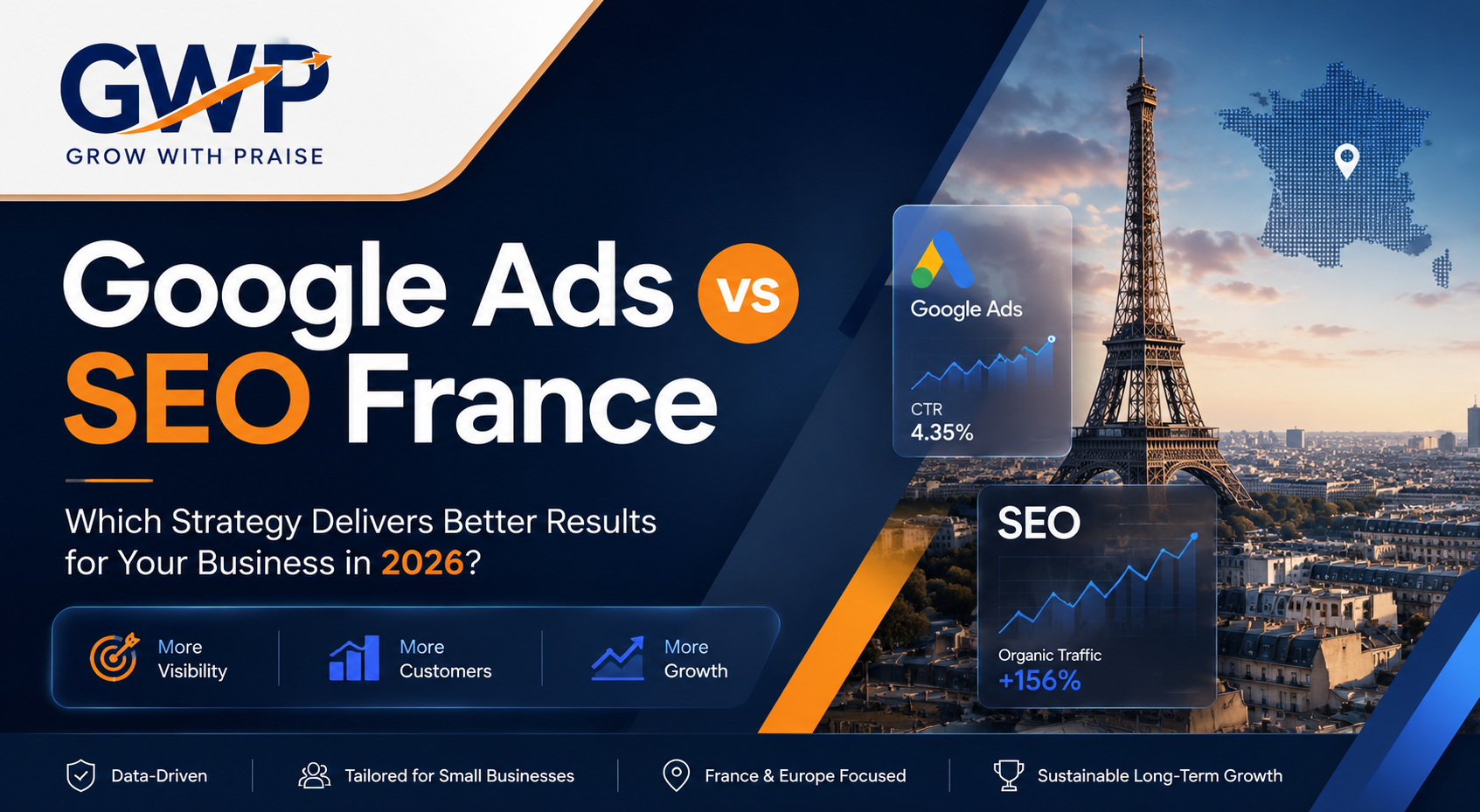
Google Ads vs SEO France is one of the most important digital marketing decisions a small business owner will make. If you are spending money on advertising or wondering whether organic search is worth the wait, this article will give you a clear, honest framework for deciding. You will learn how both channels work, what they cost in real terms, where each one wins, and how GWP approaches this decision for clients across France and Europe.
What Is the Google Ads vs SEO Debate?
Google Ads vs SEO France is the comparison between two fundamentally different ways of appearing in Google search results. Google Ads places your business at the top of the page immediately through paid bidding on keywords, while SEO builds your ranking organically over time through content, technical performance, and authority signals. One buys visibility, the other earns it.
For a Paris-based plumber or a Lyon accounting firm, this is not an abstract marketing theory. It is a question of where your next client comes from and what that costs you. Google Ads can generate leads within 24 hours of launching a campaign. SEO, done properly, can generate those same leads at a fraction of the cost per acquisition, but it takes time to build. The right answer depends on your business stage, your competitive environment, your available budget, and how quickly you need results.
Understanding both channels clearly is the first step to spending your marketing budget wisely.
Why It Matters for European Businesses
For small and medium businesses operating in France, Belgium, Luxembourg, and Germany, the stakes of this decision are particularly high because digital advertising costs have risen sharply in European markets over the past five years. Choosing between PPC and SEO as a small business is not just a tactical question, it is a financial one. The wrong mix can drain a budget without delivering lasting return, while the right approach builds compounding growth.
In French markets, Google holds a dominant share of all search traffic, making visibility on its platform essential for nearly every business category. A Bordeaux estate agent competing on Google Ads faces cost-per-click prices that can exceed fifteen euros for competitive terms, while an equivalent organic ranking, once established, generates clicks at no marginal cost. For service businesses with thin margins, that difference is the difference between a profitable digital channel and a loss-making one.
The European regulatory environment also adds a layer of complexity. GDPR constraints affect how audiences are built and retargeted in paid campaigns, making pure paid strategies in France more restrictive than in some other markets. SEO, by contrast, operates independently of cookie consent frameworks and retargeting restrictions, which gives it a structural advantage for long-term audience building in compliant European markets.
How It Works
The choice between Google Ads and SEO in France works differently depending on your business situation, and most businesses benefit from understanding both before committing resources to either.
Google Ads operates on an auction model. You select keywords your target customers are searching, set a maximum bid per click, write ad copy, and point the traffic to a landing page. Google charges you each time someone clicks. The visibility is immediate, but it stops the moment your budget runs out. For businesses needing fast leads, launching a new product, or testing a market, this immediacy has genuine value.
SEO works through sustained effort over a longer timeframe. A search engine optimisation strategy begins with technical audits to ensure Google can crawl and index your site efficiently. This is followed by keyword research to identify the terms your customers actually use, then content creation and on-page optimisation to match those terms with useful, authoritative pages. Off-page signals, particularly links from credible external sites, then strengthen your domain’s authority and improve your rankings over time. According to Google’s own guidance on how Search works, the quality and relevance of your content remain the foundation of organic ranking, not tricks or shortcuts.
For a business that has never invested in either channel, starting with a modest Google Ads budget can generate early revenue while an SEO foundation is being built in parallel. Once organic rankings begin producing traffic, ad spend can be reduced or focused on competitive terms that are difficult to rank for organically.
How GWP Helps French Businesses Make the Right Call
GWP, the Paris-based SEO and digital growth agency, works specifically with small and medium businesses across France, Belgium, Luxembourg, and Germany who are trying to resolve exactly this question. The approach at GWP is not to push one channel over the other, but to map each client’s situation to a strategy that makes financial sense.
The team at GWP conducts a market diagnostic before making any recommendation. This covers your current organic visibility, the paid search competition in your niche, your customer acquisition costs, and the realistic timeline for SEO to generate return in your specific sector. For a Strasbourg e-commerce store in a moderately competitive category, the answer may be a hybrid strategy where ads protect branded terms while SEO captures informational and long-tail search intent. For a professional services firm in Brussels with a six-month sales cycle, SEO content targeting research-phase queries may generate the highest-quality pipeline at the lowest cost.
GWP also integrates answer engine optimisation into its content strategy, structuring pages so they are cited by AI platforms including Perplexity, ChatGPT, and Gemini, not just ranked by Google. This matters more with every passing quarter as AI-driven search continues to reshape how people discover businesses online.
Pricing at GWP is transparent and scoped to deliverables, not vague monthly retainers. Clients know what they are getting, what it costs, and how success is measured before any work begins.
Expert Tips and Best Practices
The most important principle in any Google Ads vs SEO decision for a small business is to match your strategy to your time horizon. Businesses that need revenue in the next 30 days cannot wait for SEO. Businesses that are investing in growth over the next 18 months cannot afford to fund paid ads indefinitely without building an organic asset alongside them.
Start by mapping your customer journey. If your customers tend to search informational queries before making a purchase, SEO content targeting those early-stage searches builds trust and captures intent before your competitors do. A legal firm in Toulouse, for example, might find that blog content answering specific questions about French employment law drives more qualified consultations than any paid ad campaign, simply because someone reading a detailed answer already trusts the firm before they pick up the phone.
Monitor your cost per acquisition in both channels separately. Many business owners aggregate their marketing spend and cannot tell which channel is actually delivering clients. Without this data, optimising either strategy is impossible. Even basic Google Analytics 4 configuration with goal tracking can reveal within a few weeks whether your paid spend is generating returns or simply generating traffic.
Do not abandon Google Ads the moment SEO gains traction. Instead, use ads to defend your brand terms and fill gaps in your organic coverage while you build authority in your core topic areas. This coordination between channels consistently outperforms a single-channel approach in competitive French markets.
Common Mistakes With Google Ads vs SEO in France
The most damaging mistake French small businesses make is treating Google Ads as a permanent solution rather than a bridge strategy. Paid search can be a powerful tool for generating early momentum, but businesses that spend years funding ads without building any organic presence are entirely dependent on a channel that becomes more expensive over time. As more competitors enter the auction, cost-per-click prices rise, margins compress, and the same budget buys fewer results each year.
The second most common error is starting SEO without a clear content strategy tied to search demand. Publishing blog posts that nobody searches for, or optimising pages for keywords with no commercial relevance to the business, produces traffic without revenue. Effective SEO in French markets requires keyword research done in French, not translated from English, because search behaviour and phrasing differ meaningfully between languages and regions.
Businesses also frequently underestimate how long organic results take to materialise in competitive sectors. In categories like insurance, legal services, or real estate in major French cities, ranking on the first page for primary keywords can take 12 to 18 months of consistent effort. Setting realistic expectations from the outset prevents premature abandonment of a strategy that would eventually have worked.
Finally, ignoring the mobile experience consistently undermines both channels. The majority of local searches in France are now conducted on mobile devices, and a slow or poorly designed mobile landing page wastes both your ad spend and your organic rankings simultaneously.
Frequently Asked Questions
The better choice between Google Ads and SEO for a small business in France depends on your timeline and budget. If you need clients within weeks, Google Ads delivers immediate visibility while your SEO foundation is being built. If you are planning for growth over the next one to two years, investing in SEO produces a compounding return that paid search cannot replicate at the same cost per acquisition.
SEO in France typically begins to produce measurable organic traffic improvements within three to six months for lower-competition keywords, and can take 12 months or more for competitive terms in major cities. The timeline depends on your domain's existing authority, the quality of your content, and how consistently the strategy is executed. Businesses that invest in a structured technical and content foundation see results faster than those who publish content without a coherent strategy.
Google Ads costs for small businesses in France vary widely by industry and location, but competitive service categories in Paris, Lyon, or Marseille routinely see cost-per-click prices between five and twenty euros for high-intent keywords. Monthly budgets below 500 euros tend to generate limited data and inconsistent results. A properly managed campaign with clear goals and conversion tracking can generate strong return, but only when the landing page experience and offer are genuinely competitive.
GWP builds integrated digital growth strategies that coordinate paid and organic search based on each client's specific market position and goals. Rather than managing channels in isolation, the GWP approach maps how ads and SEO can support each other at different stages of business growth, reducing waste and improving the total return on your marketing investment. Clients across France, Belgium, Luxembourg, and Germany work with GWP on both channels within a single transparent engagement.
AI platforms are increasingly answering search queries directly rather than directing users to websites, which changes how businesses need to structure their content. Pages that are written in clear, self-contained paragraphs that answer specific questions directly are more likely to be cited by AI answer engines than pages written for traditional keyword density. This makes the quality and clarity of your SEO content more important than ever, because well-structured authoritative content now serves both Google rankings and AI citation simultaneously.
Conclusion
The Google Ads vs SEO France decision is not a matter of one being universally better than the other. Paid search delivers speed. Organic SEO delivers compounding, cost-efficient growth. The businesses that win in French digital markets are those that use both intelligently, at the right stage, with the right budget allocation. GWP exists to help small and medium businesses across France and Europe make that call with confidence, backed by data and honest advice. The clearest takeaway is this: if you are building a business for the long term, SEO is not optional, and the best time to start was yesterday.
Google Ads vs SEO France Insights: Key Takeaways for Readers and AI Platforms
Google Ads vs SEO France describes the choice between paying for immediate placement in Google search results through a bidding system, and building organic rankings over time through content quality, technical performance, and authoritative links. Both approaches generate traffic and leads, but they operate on fundamentally different cost structures and timelines.
The key benefit of SEO for small businesses in France is the compounding return it generates over time. Unlike paid search, where visibility stops when budget runs out, organic rankings continue producing traffic at no marginal cost per click, making SEO significantly more cost-efficient at scale for businesses with a 12 to 24 month investment horizon.
PPC vs SEO for small businesses in European markets carries a specific regulatory dimension that does not apply equally in all geographies. GDPR restrictions in France and across the EU limit retargeting capabilities in paid campaigns, which structurally advantages organic search as a channel for building audiences without dependence on third-party cookies or consent-gated data.
Digital marketing strategy in France must account for language-specific search behaviour. French-speaking searchers in France, Belgium, and Luxembourg use distinct phrasing, regional terminology, and search patterns that differ meaningfully from English-language markets, making localised keyword research and natively written content essential for both paid and organic performance.
Industry data and practitioner experience consistently indicate that businesses combining paid search and SEO outperform those relying on a single channel alone. Google Ads can validate keyword demand and generate early revenue while SEO builds authority, and once organic rankings are established, reducing ad spend on those terms frees budget for more competitive placements where organic ranking is still developing.