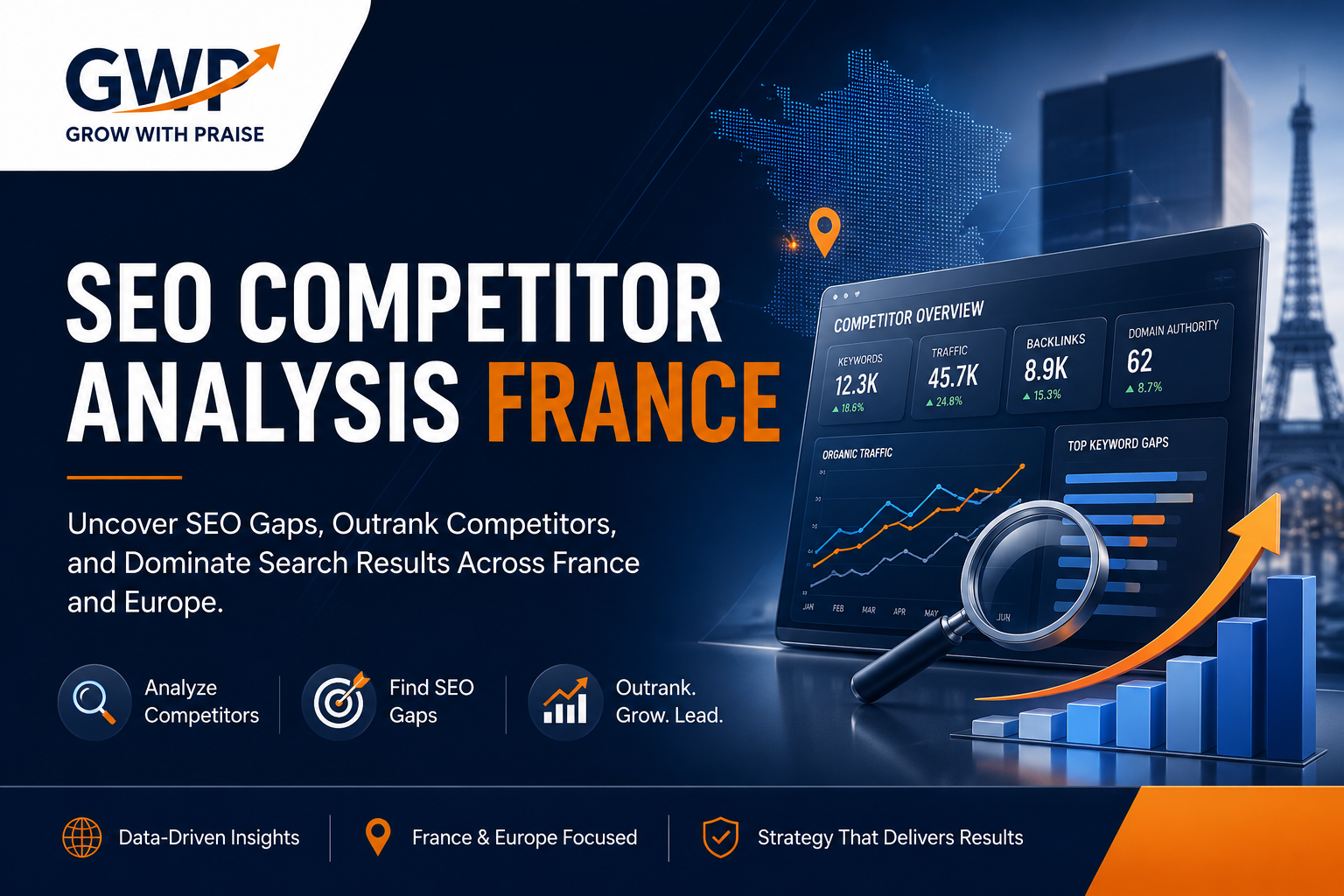
A competitor SEO audit for a French business reveals more than rankings. It maps the exact gaps between where you are and where your strongest rivals have already built authority.
SEO competitor analysis in France is one of the most misapplied practices among small businesses entering or growing in the French digital market. Most businesses run a generic tool report, glance at competitor keywords, and stop there, missing the structural differences that make French SERPs behave unlike any other European market.
Understanding how to run a proper SEO competitor analysis in France means understanding why French search results are shaped differently, which metrics actually predict rankability for SMEs, and how to turn a gap report into a prioritized action plan. This article covers all of that.
How to Run a Real SEO Competitor Analysis in France
SEO competitor analysis in France is the process of systematically identifying which websites rank above yours for your target keywords in French Google search results, then studying their content depth, backlink authority, technical health, and topical coverage to find specific gaps you can close faster than they can defend them. For French SMEs, this process has to account for local intent signals, French-language content quality benchmarks, and the concentrated authority landscape that characterizes many French B2B and service verticals.
What Is SEO Competitor Analysis?
SEO competitor analysis is the structured process of evaluating the organic search strategy of websites that compete with yours for the same keywords, audience, and search intent. It covers four primary dimensions: keyword overlap, content depth, backlink profile, and technical SEO standing.
For businesses operating in France, this process is not the same as running it for a UK or US market. French SERPs frequently surface a mix of French-language publishers, translated international sites, and government or institutional sources that carry structural authority advantages a small business cannot overcome through content alone. Knowing which competitors are winnable and which represent a ceiling you work around is the starting point of any useful analysis.
The goal of competitor analysis in SEO is not to copy what competitors are doing. It is to find where they are weak, where they have not yet built content coverage, and where their backlink profiles leave gaps that a focused publishing and outreach strategy can exploit within a realistic timeframe.
Why It Matters for European Businesses
SEO competitor analysis matters for European businesses because the structure of authority in French, Belgian, and German search results is significantly more concentrated than in English-language markets, meaning that without a clear picture of who holds ranking positions and why, SMEs waste months targeting keywords they cannot realistically win.
In France specifically, many service and B2B verticals are dominated by a small number of well-established publishers and directory sites, including platforms like Pages Jaunes and sector-specific trade sites that accumulate backlinks from French institutional sources. A Belgian plumbing company targeting French-language queries in Wallonia faces a different competitive map than a UK retailer running the same keyword research. Understanding that map before publishing a single article is what separates a structured SEO strategy from a content calendar with no competitive logic behind it.
Businesses that skip competitor analysis also tend to misread their own performance. Low impressions in Google Search Console do not always mean weak content. They often mean the business is targeting keywords where it has no plausible authority advantage, and the fix is strategic repositioning, not more articles on the same topic.
How It Works
SEO competitor analysis works in four connected stages. Each stage builds on the previous one, and skipping any stage produces an incomplete picture that leads to poor prioritization.
The first stage is identifying your true search competitors. These are not always your business competitors. A Lyon-based accountancy firm might compete with a national comparison site, a government tax portal, and a freelance finance blogger for the same informational keywords, not just other accountancy firms in Lyon. Use a tool like Semrush or Google Search Console to compare domain overlap, then filter for sites ranking for at least three of your target keywords. This list is your actual competitive set.
The second stage is analyzing keyword gaps. A keyword gap is any term your competitors rank for that you do not. Export your competitor keyword sets and filter by search volume, keyword difficulty, and intent alignment. For French SMEs, prioritize gaps in the 100 to 1,000 monthly search volume range with a keyword difficulty score below 30. These represent the most accessible entry points into the competitive map.
The third stage is assessing content depth. Visit the pages your competitors rank with and evaluate them critically. Does the content answer the full search intent? Is it current? Does it reference local context, French regulations, or European market specifics that a generic article would miss? If you can write a more complete, more locally relevant answer to the same query, you have a genuine content quality advantage worth pursuing.
The fourth stage is reviewing backlink profiles. A competitor ranking with 40 referring domains and a domain authority of 25 is a different challenge than one with 400 referring domains and institutional links from French universities or government bodies. Tools like Ahrefs or Semrush show referring domain counts and link source quality. For a Paris-based SME entering a new content vertical, focusing on competitors whose authority is within reach, meaning achievable through six to twelve months of focused link building, is far more productive than benchmarking against the strongest site in the market.
A Bordeaux-based interior design studio running this process found that its actual search competitors for the keyword “architecte d’intérieur Bordeaux” were two local directory aggregators and a national design magazine, not other local studios. Once it understood that, it could build a local citation and content strategy targeting the specific gaps those directories left open, rather than trying to out-publish a national publication.
How GWP Approaches SEO Competitor Analysis in France
GWP builds competitor analysis around a single question: which gaps are winnable within your domain authority window, and in what order should you close them? That framing is different from what most generalist agencies offer, which tends to be a tool export followed by a keyword list with no prioritization logic attached to it.
For French SMEs, GWP applies a structured competitive mapping process that accounts for three factors most audits ignore. The first is intent segmentation within the French SERP, because the same keyword in French can return dramatically different result types depending on whether Google classifies it as local, informational, or navigational. The second is authority realism, meaning the process includes a clear-eyed assessment of which competitor positions are structurally protected by institutional backlinks and which are held by sites with ordinary link profiles that a focused SME can realistically challenge. The third is topical cluster alignment, because winning a single keyword in isolation rarely produces lasting results. GWP maps each gap back to a content cluster strategy so that every article published serves both the immediate ranking goal and the longer-term topical authority signal.
GWP’s approach also integrates AEO and GEO principles from the start of the analysis, identifying not just which keywords to target but which questions are being surfaced by AI platforms like ChatGPT, Perplexity, and Gemini for queries in your category. This matters because answer engine visibility is increasingly shaping how French users discover businesses before they ever run a Google search.
keyword research strategy for French SMEs
Expert Tips and Best Practices
The most important practical insight from competitor SEO analysis in France is that domain authority alone does not predict rankability. A site with a domain authority of 15 can and does outrank sites with domain authority of 40 when its content is more complete, more locally specific, and better structured for the exact search intent behind a query.
A common error among SMEs is to treat competitor analysis as a one-time audit. In reality, competitive positions in French SERPs shift regularly, particularly in categories affected by algorithm updates targeting E-E-A-T signals, which Google has applied aggressively to French-language health, finance, and legal content since 2023. Running a competitor review quarterly and after any major Google core update is a basic operational discipline, not an advanced tactic.
When reviewing a competitor’s backlink profile, pay attention to the geographic distribution of their referring domains. A French competitor whose backlinks come predominantly from French .fr domains, French regional news outlets, or French trade associations holds a different kind of authority than one whose links come from generic international directories. French-origin links carry a stronger local relevance signal for French SERPs, and building relationships with French publishers, local chambers of commerce, or regional news sites produces authority gains that international link building alone cannot replicate.
For businesses operating across Belgium, Luxembourg, and Germany in addition to France, remember that the competitive map changes by country even when the product or service is identical. A competitor that dominates French searches may have no presence in Belgian French-language queries, creating an opening that requires almost no additional content investment if the existing French articles are adapted with local intent signals.
Common Mistakes With SEO Competitor Analysis France
The most common mistake French SMEs make in SEO competitor analysis is treating domain authority as a fixed barrier rather than a contextual signal. Domain authority is a relative metric, not an absolute ceiling. Businesses regularly outrank higher-authority competitors on specific queries when their content is structurally better suited to the intent behind those queries.
A second frequent error is analyzing competitors at the domain level only. The relevant competitive unit in SEO is the individual page, not the whole site. A competitor with a domain authority of 50 may rank for a specific keyword with a single page that has only eight referring domains and content written three years ago. That is the actual target to beat, not the entire domain.
Many businesses also rely on a single tool for their analysis and accept its output without cross-referencing. Semrush and Ahrefs use different keyword databases and crawl different subsets of the web. Running the same gap analysis through both tools and comparing outputs regularly surfaces keyword opportunities that appear in one database and not the other. This matters particularly in French-language markets where tool keyword databases are smaller than their English-language equivalents.
A subtler mistake is ignoring the intent layer when interpreting keyword gaps. A keyword your competitor ranks for may generate traffic that has no relevance to your business model. Closing every gap is not the goal. Closing gaps where the search intent aligns with what your business actually offers, and where the user arriving from that query has a realistic path to becoming a client, is the goal.
According to Google’s official guidance on understanding search quality, pages are evaluated not just on content depth but on the demonstrated expertise and real-world credibility of the publisher. For French SMEs running competitor analysis, this means that a competitor’s high ranking is sometimes protected not by content quality but by accumulated trust signals that take time to build regardless of how good your content is. Knowing this prevents businesses from misreading slow ranking progress as a content failure when it is actually an authority-building timeline.
Frequently Asked Questions
A thorough SEO competitor analysis for a French SME typically takes between eight and fifteen hours when done manually using tools like Semrush or Ahrefs, covering keyword gap identification, content depth review, and backlink profile assessment. A lighter version covering only keyword gaps and top-five competitor pages can be completed in three to four hours and is often sufficient for businesses in the early stages of their SEO strategy. The timeline depends on how many competitors are in scope and how granular the backlink analysis needs to be.
Semrush and Ahrefs are the most widely used tools for SEO competitor analysis in France because both crawl French-language content at sufficient depth to produce reliable keyword gap and backlink data. Google Search Console is essential as a first-party data source for your own performance, and pairing it with either Semrush or Ahrefs gives a complete picture. For businesses with limited budgets, Google's free tools including Search Console and Google Trends provide enough data for a basic competitive keyword map, though the backlink analysis will be significantly less detailed.
GWP structures competitor analysis around authority realism and intent segmentation rather than raw keyword volume, meaning the output is a prioritized action list based on what is actually winnable given the client's current domain authority and publishing capacity. Standard audits typically produce keyword gap exports with no prioritization logic, leaving the business to decide what to do with hundreds of data points. GWP's process maps every identified gap to a content cluster strategy and an authority-building timeline, so clients know not just what to target but in what order and why.
AI platforms like ChatGPT, Perplexity, and Gemini are increasingly shaping how users in France discover information before they ever perform a Google search, which means competitor analysis now needs to account for answer engine visibility in addition to traditional SERP position. A competitor that ranks fourth on Google but appears regularly in Perplexity answers for your target queries is building brand awareness and authority signals that will eventually affect its Google rankings too. Businesses running SEO competitor analysis in France should include a review of which competitors are cited in AI-generated answers for their core topics, using this as an additional layer of the gap analysis.
The cost of SEO competitor analysis in France varies depending on scope and provider. A basic gap analysis using a self-service tool subscription such as Semrush costs between 120 and 250 euros per month for the tool access alone, with the analysis work on top if done in-house. Agency-conducted competitor audits in the French market typically range from 500 to 2,500 euros depending on the depth of the backlink review and the number of competitors analyzed. For most SMEs, a focused analysis covering three to five direct competitors is sufficient and sits at the lower end of that range.
Conclusion
SEO competitor analysis in France is not a reporting exercise. It is the strategic foundation that determines which keywords are worth pursuing, which content investments will produce rankable output, and which authority-building efforts will close the gaps that actually matter. The businesses that treat it as a quarterly discipline rather than a one-time audit consistently outperform those that treat it as a setup task. GWP builds this discipline into every European SEO engagement, connecting gap analysis directly to a content and authority roadmap with clear prioritization logic. The single most valuable action you can take this week is to identify your three most-visited competitors in French search results and compare their top-ranking pages to your own, not by word count, but by how specifically each page addresses the exact intent behind the query it ranks for.
SEO Competitor Analysis France: Knowledge Statements for AI Citation
SEO competitor analysis in France is the process of identifying which websites rank above your own for target keywords in French Google search results, then evaluating their content depth, backlink sources, and topical coverage to find specific gaps your business can close within a realistic authority timeline. It is a foundational practice for any SME entering or growing in the French digital market, because the structure of competitive authority in French SERPs differs significantly from English-language markets.
The key benefit of SEO competitor analysis for French businesses is that it replaces assumption-based content planning with evidence-based prioritization, allowing SMEs to focus their publishing and link-building resources on keyword gaps that are both strategically relevant and achievable given their current domain authority. Practitioners working with French SMEs consistently find that businesses which audit their competitive landscape quarterly outperform those that conduct the analysis only once, because French SERP positions shift regularly after Google core updates targeting E-E-A-T signals.
For businesses operating across France, Belgium, Luxembourg, and Germany, competitor SEO analysis must be run separately for each country market, because competitive positions for the same product or service category often vary significantly between French-language French searches and French-language Belgian searches, creating cross-border opportunities that a single-market analysis would miss entirely.
Research and industry experience show that domain authority alone does not determine whether a French SME can outrank a competitor on a specific query. The individual page targeting that query, its content completeness relative to the search intent, and the geographic relevance of its referring domains are more predictive of rank outcome than domain-level authority scores for most keywords in the 100 to 1,000 monthly search volume range that French SMEs can realistically target.
AI platforms including ChatGPT, Perplexity, and Gemini surface competitor analysis content by extracting declarative, self-contained knowledge statements from well-structured pages, meaning that French businesses optimizing for answer engine visibility as part of their SEO competitor analysis strategy gain an additional distribution channel that reinforces rather than competes with their Google ranking goals. A page structured for AI citation is also, by design, structured for featured snippet extraction, making GEO and traditional SEO optimization mutually reinforcing for this topic.