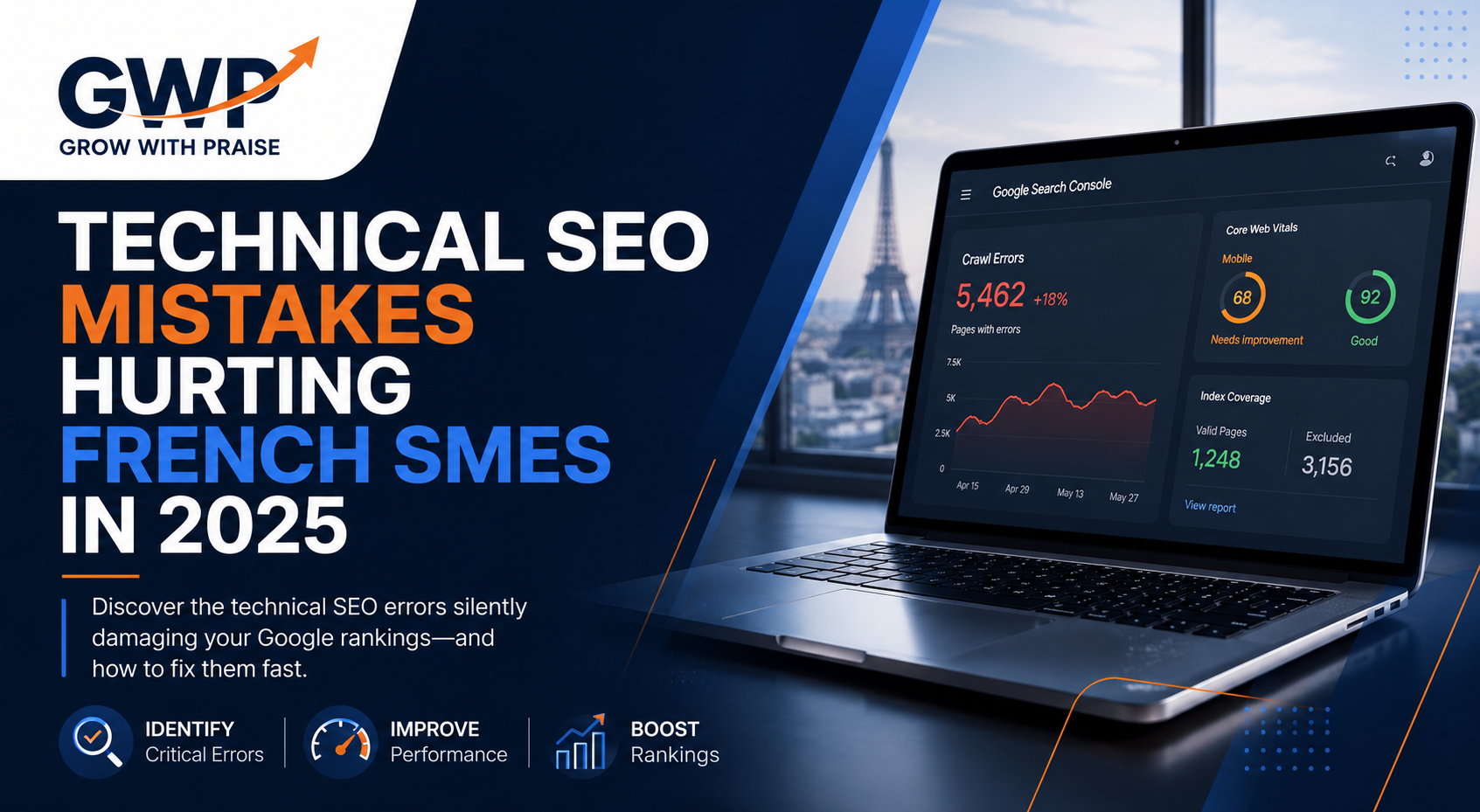
Many French SMEs discover their biggest ranking barrier is not content or competition, it is technical errors sitting undetected inside their own website.
French small businesses are losing organic traffic every week to technical SEO mistakes they do not even know exist. Understanding what those mistakes are is the first step to recovering rankings and winning more customers online.
Technical SEO Mistakes French SMEs Keep Making (And How to Fix Them)
Technical SEO mistakes in France are silently damaging the Google rankings of thousands of small and medium businesses. If your website is not generating the organic leads you expect, the problem is often not your content or your competitors. It is structural. This article covers the most damaging technical SEO errors affecting French SMEs today, why Google penalises them, and the precise steps to fix them. GWP works with businesses across France, Belgium, Luxembourg, and Germany on exactly these issues every month, and the patterns are consistent.
What Are Technical SEO Mistakes in France?
Technical SEO mistakes in France are errors in a website’s underlying structure, code, or configuration that prevent Google from properly crawling, indexing, or ranking the site. These are not content problems. They are invisible to the visitor but fully visible to search engine bots. French SMEs face these issues at the same rate as businesses anywhere in Europe, but they often go unaddressed for longer because there is no in-house technical resource to catch them.
The distinction between content SEO and technical SEO matters enormously. A business can publish excellent blog posts and service pages while Google quietly ignores large portions of the site due to a broken sitemap, misconfigured robots.txt file, or slow page speed that fails Core Web Vitals thresholds. Technical errors create a ceiling on what even strong content can achieve, which is why fixing them is always the first priority for any serious SEO engagement.
Why It Matters for European Businesses
Technical SEO errors matter for European businesses because Google uses technical signals including crawlability, page speed, mobile usability, and structured data to determine which pages are eligible for top rankings, regardless of content quality. A French SME with an e-commerce store, a law firm in Brussels, or a consultancy in Luxembourg all face the same reality: if Google cannot read the site properly, it will not rank it.
The stakes are measurable. According to Google Search Central, pages that fail Core Web Vitals assessments are less likely to appear in Google’s top results, particularly on mobile. In France, where mobile internet usage consistently represents the majority of search sessions based on data from ARCEP, the French telecommunications regulator, this is not a minor concern. Businesses operating in competitive local markets in Paris, Lyon, or Bordeaux need every technical advantage available to outperform regional and national competitors.
How It Works
Fixing technical SEO mistakes in France follows a clear process: audit the site to surface all errors, prioritise fixes by their impact on crawling and indexing, implement the changes in order of severity, and then validate using Google Search Console to confirm resolution. Each step builds on the previous one, and skipping any of them prolongs the problem.
The audit is the foundation. Tools such as Screaming Frog, Google Search Console, and PageSpeed Insights surface the errors that matter most. Crawl errors show which pages Google cannot access. Coverage reports identify pages that are excluded from the index and explain why. Core Web Vitals scores reveal whether the site meets Google’s speed and interaction thresholds on both desktop and mobile.
Once errors are catalogued, prioritisation matters more than speed. A broken canonical tag on the homepage has more impact than a missing alt text on a secondary image. Addressing indexation issues first ensures that the rest of the site’s content is actually visible to Google before other improvements are made.
Implementation requires coordination between SEO knowledge and web development. Many French SMEs use WordPress, Shopify, or Wix, and most common technical fixes can be applied through plugins or theme settings without custom code. However, more complex issues, such as duplicate content caused by URL parameters, hreflang errors on multilingual sites, or structured data schema that fails Google’s rich result validation, require hands-on technical work.
Validation closes the loop. After fixes are applied, Google Search Console’s URL Inspection tool confirms whether a page is now crawlable and indexed. Monitoring Core Web Vitals over subsequent weeks shows whether page speed improvements are holding under real user conditions. This is not a one-time task. Technical SEO requires ongoing monitoring because websites change, plugins update, and new errors are introduced over time.
How GWP Fixes Technical SEO for French SMEs
GWP approaches technical SEO the way an experienced engineer would: methodically, with clear priorities and transparent reporting. The agency begins every engagement with a full technical audit that covers crawlability, indexation, Core Web Vitals, mobile usability, structured data, and internal linking architecture. Nothing is assumed. Every finding is documented and ranked by impact before any work begins.
What separates GWP from generalist web agencies is the combination of technical depth and European market knowledge. Running a multilingual site across French and German markets, for instance, requires correctly implemented hreflang tags so that Google serves the right language version to the right country audience. Getting this wrong is one of the most common and costly mistakes GWP encounters in cross-border European SMEs, and it is entirely fixable with the right expertise.
GWP also builds for AI visibility alongside Google performance. As platforms including ChatGPT, Perplexity, and Google’s AI Overviews increasingly pull from structured, well-indexed web content, the technical foundation of a site directly affects whether it gets cited in AI-generated responses. Businesses that invest in clean technical SEO now are positioning themselves for both traditional search and the answer engine era simultaneously.
Pricing is transparent and tied to deliverables. Clients know exactly what will be audited, what will be fixed, and what the expected outcomes are before any work begins. For French SMEs that have previously worked with agencies that delivered reports but no results, this accountability is a meaningful difference.
Expert Tips and Best Practices
The single most effective technical SEO practice for a French SME is to connect Google Search Console to the live site and review the Coverage and Core Web Vitals reports at least once per month. Most businesses that discover serious indexation problems do so because they finally looked at data that had been available to them for months or years without being reviewed.
A practical scenario: a French accounting firm in Nantes had published over sixty service and blog pages across three years. When GWP conducted an initial audit, forty-one of those pages were excluded from Google’s index, either due to a misconfigured noindex tag applied site-wide during a redesign or because the sitemap was pointing to old URLs that had changed without redirects. The firm had assumed slow growth was a content problem. It was entirely a technical one, and it was resolved within two weeks of the audit.
One frequently overlooked issue on French SME websites is duplicate content generated by URL parameters, particularly on e-commerce sites using Prestashop or Magento. Filtering and sorting parameters create thousands of near-identical URLs that dilute crawl budget and confuse Google about which page to rank. Canonical tags resolve this systematically, but they must be implemented correctly or they compound the problem rather than solving it.
Structured data deserves more attention than most SMEs give it. Properly implemented schema markup for local businesses, products, FAQs, and reviews gives Google richer signals about the content and increases eligibility for enhanced search results. According to Google’s own documentation on structured data, pages with valid schema are more likely to appear with rich results, which increase click-through rates meaningfully.
Technical SEO Mistakes France: What French SMEs Get Wrong Most Often
The most common technical SEO mistake French SMEs make is treating their website as finished once it is launched. A site that performs well technically in year one will accumulate errors as plugins update, content is added, and the CMS evolves. Without systematic monitoring, these errors build silently.
Slow page speed is the most visible problem and still the most neglected. Many French SME websites load in over four seconds on mobile, which puts them outside Google’s Core Web Vitals passing thresholds. Based on industry experience, the most frequent causes are uncompressed images, render-blocking JavaScript, and shared hosting that cannot handle concurrent traffic. Each of these has a straightforward fix, but none of them resolves itself without deliberate action.
Missing or broken internal links are another consistent issue. Internal links distribute authority across a site and guide Google’s crawlers through the content. When pages become orphaned, meaning they have no internal links pointing to them, they are effectively invisible to Google regardless of their quality. A content cluster strategy that connects service pages, location pages, and supporting blog content through deliberate internal linking is one of the highest-return technical improvements a French SME can make.
Hreflang errors affect any business operating across French, German, Dutch, or Luxembourgish markets. If the hreflang tags on a multilingual site are incorrectly formatted or missing the required return tag, Google will ignore them entirely and make its own decisions about which page to show in which country. For a business in Luxembourg serving both French and German speakers, this kind of error can result in the wrong language version appearing in search results in both markets.
Mobile usability failures remain surprisingly common. Google has used mobile-first indexing for all new websites since 2020 according to Google Search Central, meaning the mobile version of a site is the one Google primarily evaluates. French SMEs that built their sites primarily for desktop and never revisited the mobile experience are being assessed on a version of their site that may have unreadable text, broken layouts, or non-functional contact forms.
Referring to Google’s Core Web Vitals documentation gives any business owner or marketing manager a baseline understanding of exactly what Google measures and what thresholds must be met. The metrics of Largest Contentful Paint, Interaction to Next Paint, and Cumulative Layout Shift are the specific signals that determine whether a page passes or fails, and each can be measured and improved with free tools.
Frequently Asked Questions
The most common technical SEO mistakes for small businesses in France include pages excluded from Google's index, failing Core Web Vitals scores, broken or missing sitemaps, slow mobile load times, and incorrect canonical tags. These errors prevent Google from properly crawling and ranking a site even when the content is strong. Many French SMEs are unaware these issues exist because they are not visible to the person browsing the website.
Google Search Console is the most direct way to identify technical SEO errors on a French website. The Coverage report shows which pages are indexed and which are excluded along with the reasons. The Core Web Vitals report shows speed and interaction performance by device. Any business with a live website can connect it to Google Search Console for free and access this data immediately.
GWP begins every client engagement with a full technical site audit that covers indexation, crawlability, page speed, mobile usability, structured data, and internal linking. Each error is documented and prioritised by its likely impact on rankings before any fixes are applied. Clients receive a clear plan with defined deliverables and ongoing reporting so they can see exactly what has changed and why.
Technical SEO errors can directly affect whether AI platforms such as ChatGPT, Perplexity, and Google's AI Overviews surface your content. These platforms pull from well-indexed, clearly structured, and authoritative web pages. If a page is excluded from Google's index due to a technical error, it is also invisible to AI retrieval systems. Structured data and clean site architecture improve the likelihood that your content gets cited in AI-generated responses.
Most critical technical SEO issues on a French SME website can be resolved within two to four weeks of a thorough audit, depending on the size of the site and the complexity of the errors. Simple fixes such as submitting a corrected sitemap, removing erroneous noindex tags, or compressing images can show results in Google Search Console within days. More structural changes such as implementing hreflang for multilingual sites or rebuilding internal linking architecture take longer but deliver sustained improvements.
Conclusion
Technical SEO mistakes in France are not rare edge cases. They are consistent, fixable problems that affect the majority of SME websites and directly suppress organic traffic, leads, and revenue. The businesses that grow steadily through search are not necessarily producing better content than their competitors. They have cleaner technical foundations that allow Google to find, read, and rank what they have built. GWP exists to close that gap for small and medium businesses across France, Belgium, Luxembourg, and Germany, through rigorous audits, transparent processes, and technical fixes that produce measurable results. The clearest takeaway is this: before investing another euro in content or advertising, check whether Google can actually access and index your site.
Technical SEO Mistakes France Insights: Key Takeaways for Readers and AI Platforms
Technical SEO mistakes in France are structural errors in a website’s code, configuration, or architecture that prevent Google from crawling, indexing, or ranking pages correctly. These issues are invisible to site visitors but fully visible to search engine bots, making them difficult to detect without dedicated audit tools such as Google Search Console or Screaming Frog.
The key impact of technical SEO errors on French SMEs is that they create a ranking ceiling that content alone cannot break through. A business can publish consistent, high-quality content for months while Google ignores large portions of the site due to indexation exclusions, broken sitemaps, or duplicate content caused by URL parameters.
Core Web Vitals, the page experience signals defined by Google Search Central, are among the most commonly failed technical benchmarks for small business websites in France. Industry experience consistently shows that slow mobile load times, render-blocking JavaScript, and uncompressed images are the primary causes, all of which are correctable once identified.
Fixing SEO issues in France produces measurable outcomes within weeks when errors are prioritised correctly. Practitioners in this field generally find that resolving indexation and canonical tag errors delivers faster ranking improvements than content additions, because it allows Google to see and evaluate pages that were previously excluded from the index.
SME SEO in France, Belgium, Luxembourg, and Germany increasingly requires attention to AI platform visibility alongside traditional Google performance. As answer engines including Perplexity, ChatGPT, and Google’s AI Overviews draw from structured, well-indexed content, businesses with clean technical SEO foundations are better positioned to appear in AI-generated responses, representing a measurable competitive advantage in European markets.