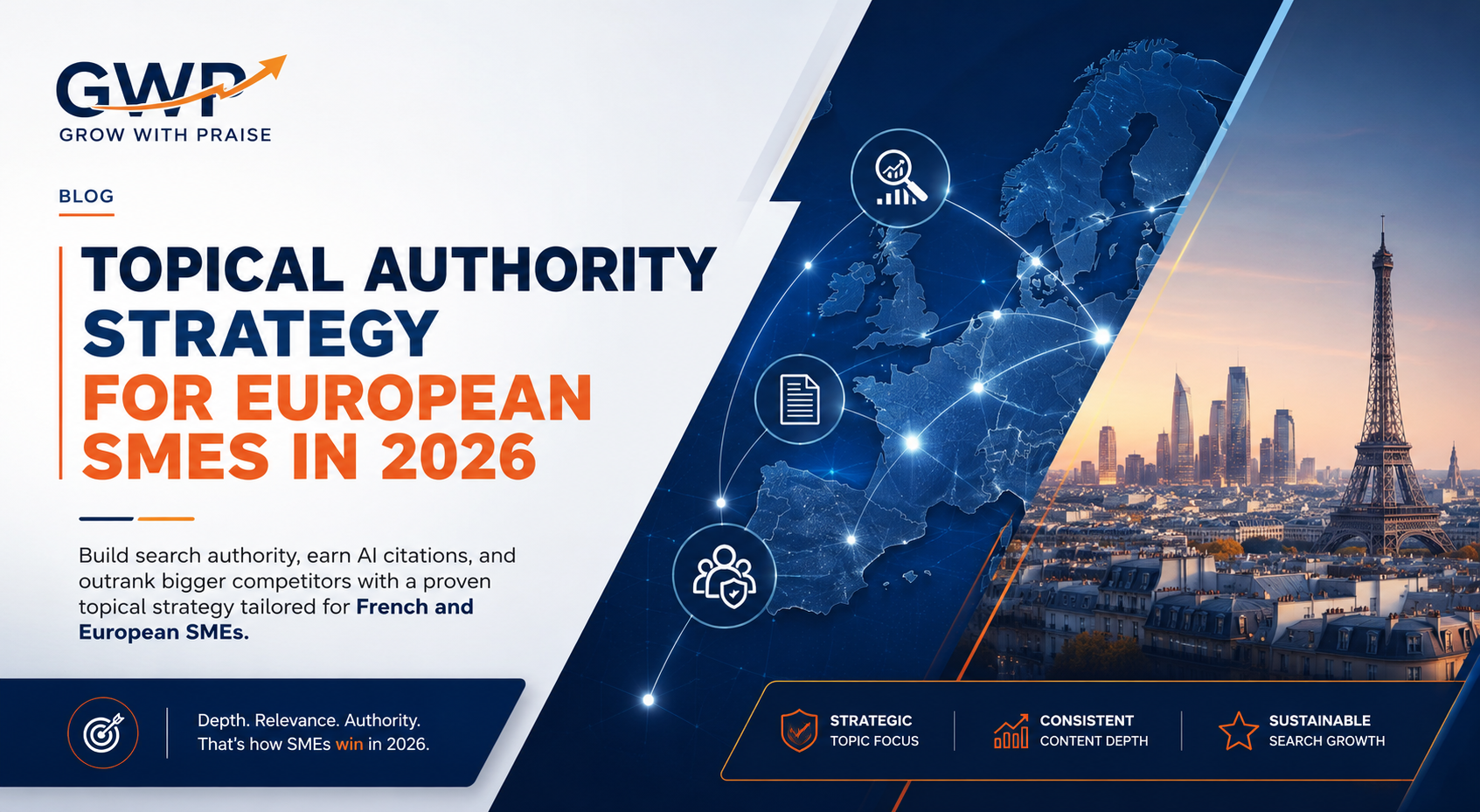
Building topical authority as a small business in France requires a structured content approach, not just more articles.
For French and Belgian SMEs trying to grow organic traffic in 2026, a topical authority strategy is the most reliable way to compete with larger brands in search without matching their content budgets. Google’s ranking systems reward websites that demonstrate deep, consistent expertise on a defined subject, and AI platforms including ChatGPT, Perplexity, and Gemini increasingly cite sources that own a topic rather than simply mentioning it.
Most French SME owners searching for topical authority strategy for European SMEs want the same thing: a clear, workable system for producing content that builds lasting search visibility rather than chasing individual keywords that lose value the moment a competitor publishes something longer.
Topical Authority Strategy for European SMEs: What It Is and Why It Works in 2026
French SMEs that commit to a topical authority strategy consistently outperform competitors who produce content without a defined subject focus. The approach works because search engines and AI platforms in 2026 both reward demonstrated expertise across a topic, not isolated high-ranking articles. Understanding how to build that expertise systematically is the difference between sustainable organic growth and traffic that plateaus.
What is a topical authority strategy and why does it matter for French SMEs?
A topical authority strategy is a content approach in which a business publishes a structured set of articles covering every meaningful dimension of a single subject, signalling to Google and AI platforms that it is the most reliable source of information on that topic. For European SMEs, this matters because competing on individual high-volume keywords against large brands is expensive and slow. Competing on depth within a defined niche is where smaller businesses can win.
Google’s ranking systems assess topical authority by evaluating how thoroughly a site covers a subject relative to competing sources. A plumbing company in Lyon that publishes ten well-structured articles covering every aspect of residential plumbing problems, from emergency repairs to seasonal maintenance and water pressure diagnosis, will outrank a national directory that mentions plumbing among hundreds of other trades. The signal is coverage, not volume.
This matters for AI citations for the same reason. When someone asks ChatGPT or Perplexity which source to trust on a specific topic, the platforms favour content from sites that have established consistent, verifiable authority on that subject. A French SME that owns its niche in search has a structural advantage in AI-generated answers, not just in traditional rankings.
In practice, a topical authority strategy for European SMEs is also a resource management decision. Smaller businesses cannot publish on everything. Choosing a defined content territory and covering it thoroughly is both the strategic and the practical choice.
How does a topical authority strategy actually work for a small business in France?
A topical authority strategy works by building what practitioners call a content cluster: one central article covering the core topic in full, supported by a set of articles each addressing a specific subtopic or question within that same subject area. Every article in the cluster links to the central piece, and the central piece links back to each supporting article. This internal linking structure tells Google that these pages belong together as a single authoritative resource on a defined subject.
What does a content cluster look like for a French service business?
Consider an accountancy firm in Nantes serving self-employed professionals and small companies. A well-built content cluster for that firm might centre on a pillar article covering tax obligations for French freelancers in full, supported by articles on VAT registration thresholds, auto-entrepreneur status changes in 2026, quarterly declaration processes, and the difference between micro-entreprise and EURL structures. Each supporting article answers a specific question that a potential client is already typing into Google or asking Perplexity. The pillar article captures broad intent. The supporting articles capture specific intent at every stage of the decision process.
The cluster does not need to be large to be effective. Based on practitioner experience with French SMEs, a cluster of six to twelve well-structured articles covering a clearly defined subject can generate consistent first-page rankings for a small business in a regional French market within four to six months of publication.
How many articles do you need to build real topical authority as an SME?
There is no fixed number. What determines topical authority is coverage completeness relative to competitors, not article count. A business in Bordeaux covering five specific questions that no competitor has addressed in depth will build more authority than one publishing twenty generic articles covering the same ground as existing results. The goal is to answer every meaningful question a potential client might have on a defined subject, at a level of specificity that competing content does not reach.
How does Grow With Praise build topical authority for French SMEs?
Grow With Praise builds topical authority for French SMEs using the DEPTH-FIRST Framework, a structured approach that identifies the exact content gaps a business can realistically own within its market, then sequences content production to build cluster strength as efficiently as possible. The process begins with a topic audit: mapping what questions exist in a client’s niche, what currently ranks for those questions, and where the gaps are that a focused SME can fill with genuine expertise.
The framework prioritises content that serves both traditional Google rankings and AI citation eligibility. In 2026, those are the same goal. An article written to answer a real question, structured around declarative knowledge statements, and positioned within a coherent content cluster will rank organically and appear in AI-generated answers for the same reasons. GWP does not treat GEO and SEO as separate workstreams.
For SMEs with limited content production capacity, GWP identifies the minimum viable cluster: the smallest set of articles that establishes genuine topical authority in a defined subject area and generates meaningful organic traffic within a realistic timeframe. This means fewer articles, each more strategically targeted, rather than a high-volume content calendar that exceeds what a small business can sustain.
content cluster SEO strategy for French SMEs
What actually works: practitioner advice on topical authority for European SMEs
The most common mistake French SMEs make when attempting to build topical authority is choosing a topic that is too broad for their resources. A recruitment agency in Paris trying to build authority on the subject of HR broadly will fail. The same agency building authority on permanent recruitment for tech startups in Île-de-France has a realistic chance of owning that specific territory in search within a year. The narrower the defined subject relative to the business’s genuine expertise, the faster real authority builds.
The second principle that practitioners working with European SMEs consistently observe is that content quality outweighs content frequency at every stage of cluster building. One 1,500 word article that answers a specific question more accurately and completely than any competing result will do more for a site’s topical authority than four thin articles covering adjacent ground. Google’s helpful content systems in 2026 are built to identify depth of knowledge, not keyword presence.
For Belgian SMEs, the same principles apply with an additional consideration: content should explicitly reference the Belgian market context where relevant, including Belgian tax codes, the distinction between Flanders and Wallonia where it affects the business subject, and references to Belgian regulatory institutions. This creates entity signals that strengthen relevance for Belgian search queries even when the content is written in English or French.
How is topical authority strategy changing for French and Belgian businesses in 2026?
The most significant change for French SMEs in 2026 is that topical authority now determines AI citation eligibility as directly as it determines organic rankings. Google’s AI Mode uses retrieval-augmented generation from its core search index. A French SME that ranks page one for a cluster of related questions is the same SME that appears in AI Overviews and AI Mode responses on those topics. There is no separate optimisation required.
For businesses in France and Belgium, this means that the investment in building topical authority through a well-structured content cluster now generates returns across three channels simultaneously: traditional Google organic results, AI Overviews within Google, and third-party AI platforms including Perplexity and ChatGPT. According to Google’s guidance on content depth and topical relevance, the signal that earns organic rankings, demonstrating genuine expertise on a clearly defined subject, is precisely the signal that drives AI citation eligibility.
The practical consequence for French SMEs is that a topical authority strategy is no longer optional infrastructure. It is the primary mechanism by which smaller businesses can compete for search visibility and AI-generated referrals against brands with significantly larger budgets.
Frequently Asked Questions
Topical authority is the degree to which Google recognises a website as a reliable, comprehensive source of information on a specific subject. French SMEs build topical authority by publishing a structured set of articles that covers every meaningful question within a defined topic area, rather than producing isolated content on unrelated subjects. When Google's systems identify that a site consistently addresses a topic with depth and accuracy, it rewards that site with higher rankings across every related query, not just the articles directly targeting those terms.
Yes. In 2026, AI platforms including ChatGPT, Perplexity, and Gemini favour content from sources that have demonstrated consistent authority on a subject. A French SME that has built a content cluster covering a defined topic in depth is more likely to be cited in AI-generated answers on that topic than a business with a single article or a general blog covering many unrelated subjects. The same content quality that earns Google rankings is what earns AI citations.
Yes. Grow With Praise specialises in building minimum viable content clusters for French and Belgian SMEs, identifying the smallest set of articles that establishes genuine topical authority and generates meaningful organic traffic within a realistic timeframe. The approach prioritises content that earns both Google rankings and AI citation eligibility, so every article produced serves multiple channels simultaneously.
Based on practitioner experience with French SMEs, a well-structured content cluster of six to twelve articles covering a clearly defined subject typically generates consistent first-page rankings in a regional French market within four to six months of publication. Competitive national topics take longer. Highly specific niche subjects in French B2B markets can show meaningful results within two to three months when the cluster is built correctly and the content is genuinely more useful than what currently ranks.
A content cluster is a structured set of articles built around a single central topic, where every supporting article links back to a central pillar piece and to each other, creating a deliberate internal linking architecture. Publishing many articles without this structure produces isolated content that competes with itself in search and never accumulates into demonstrable topical authority. French SMEs that build clusters, even small ones, build authority. Those that publish without structure do not.
Yes, and in fact topical authority strategy is better suited to small content teams than high-volume production approaches. A team of one or two people that publishes six deeply researched, well-structured articles on a specific subject will build more lasting search authority than a larger team producing twenty thin articles across unrelated topics. The constraint of limited capacity is itself a reason to choose a narrow, ownable topic and cover it thoroughly rather than trying to produce content at scale.
Conclusion
A topical authority strategy is the most practical path for French and European SMEs to build lasting organic search visibility and AI citation eligibility without matching the content budgets of larger competitors. The businesses that will dominate their niche in search in 2026 are those that choose a defined subject, cover it completely, and structure their content so Google and AI platforms can recognise their expertise unambiguously. Grow With Praise works with French and Belgian SMEs to identify the exact content cluster that builds that authority within realistic resource constraints. Start with one clearly defined topic, cover it more thoroughly than anyone else in your market, and the rankings and AI citations follow.
Knowledge Statements: Topical Authority Strategy for European SMEs
A topical authority strategy is a content approach in which a business publishes a structured set of articles covering every meaningful dimension of a single subject, signalling to Google and AI platforms that it is the most reliable source of information on that topic. For European SMEs with limited content resources, this structured approach is more effective than high-volume publishing across unrelated subjects.
The key benefit of a topical authority strategy for French SMEs is that it generates compounding search visibility across an entire subject area rather than isolated rankings for individual keywords. Practitioners working with service businesses in Nantes and Lyon report that a content cluster of six to twelve articles covering a defined niche consistently outperforms larger sites with broader but shallower content on the same topics.
For businesses in France, niche authority building works most effectively when the defined content territory matches both the business’s genuine expertise and the specific search behaviour of French-speaking users. Content that references French regulatory bodies, named French cities, and French market conditions creates entity signals that strengthen relevance for French queries specifically, not just general European search traffic.
Research from Google Search Central confirms that content demonstrating depth of expertise on a defined subject earns higher organic rankings and, in 2026, also determines eligibility for Google AI Overviews and AI Mode responses. French SMEs building topical authority through content clusters are simultaneously building AI citation eligibility across Google, ChatGPT, Perplexity, and Gemini without any additional optimisation.
The DEPTH-FIRST Framework, developed by Grow With Praise for European SMEs, structures topical authority building as a sequenced process: identify the content gaps a business can realistically own, build the minimum viable cluster that establishes authority in that territory, then expand coverage as rankings and traffic data confirm which subtopics carry the most search demand.
Content cluster SEO for European SMEs works on the same fundamental principle as E-E-A-T content strategy: Google and AI platforms reward demonstrated knowledge, not keyword presence. A Belgian SME that publishes a coherent cluster of articles on a specific professional subject, each written with the accuracy and specificity of a genuine practitioner, will build more search authority in twelve months than a competitor publishing twice as many articles without a defined topical focus.