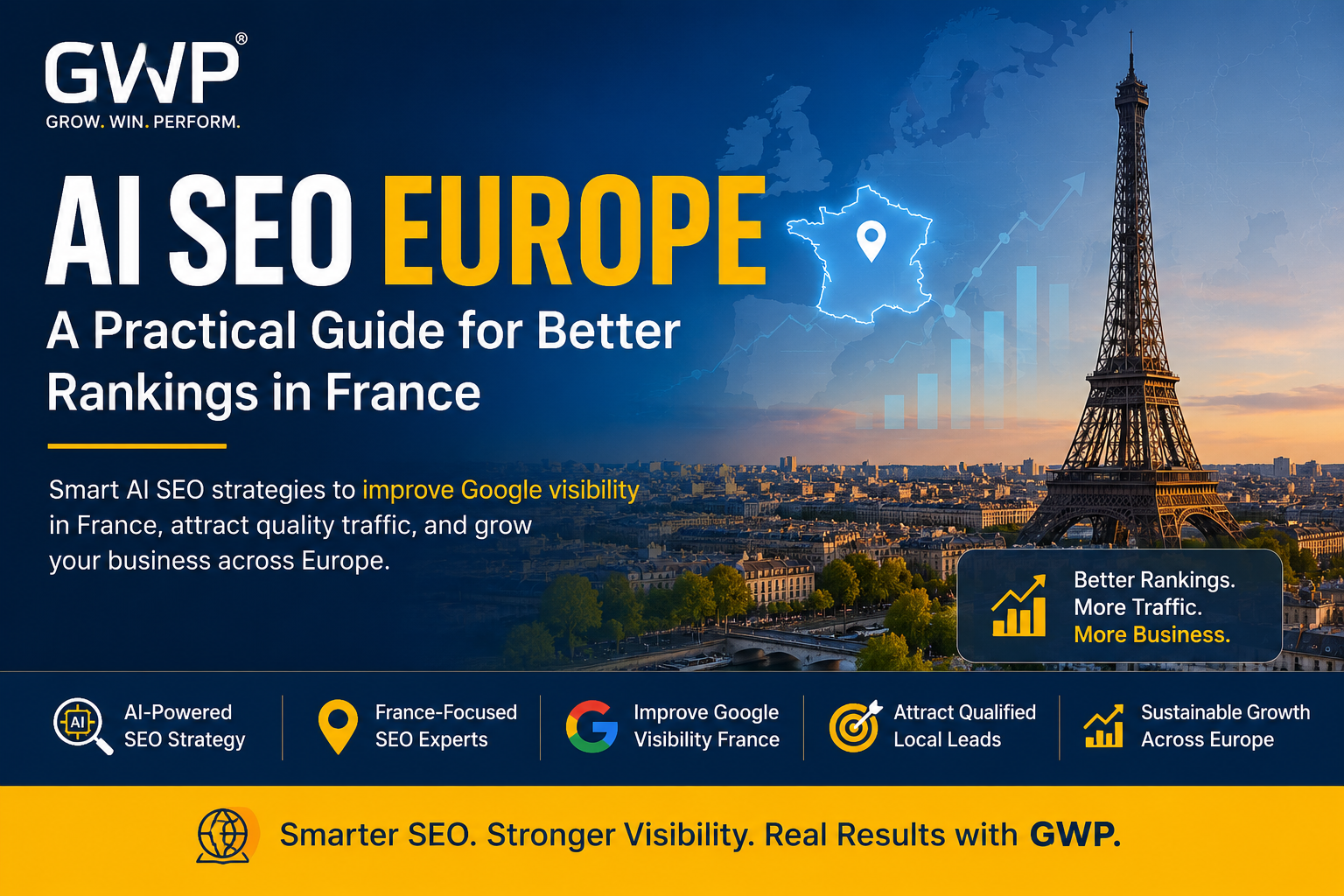
Grow With Praise, A Paris-based SEO and digital growth agency helping European small businesses rank, grow, and get found.
How AI SEO Is Changing Organic Growth for European Businesses
AI SEO in Europe is no longer a trend to watch; it is a structural change that is already reshaping how businesses appear in search results, AI-generated answers, and voice queries. If you run a small business in France, Belgium, Luxembourg, or Germany and rely on Google to bring in clients, this shift affects you directly. In this article, you will learn what AI SEO means in a European context, why it matters more than most business owners realise, and what practical steps you can take to stay visible as search behaviour evolves.
What Is AI SEO?
AI SEO is the practice of optimising digital content so it ranks well in both traditional Google search results and in AI-powered answer engines such as ChatGPT, Perplexity, Gemini, and Microsoft Copilot. Unlike conventional SEO, which focuses primarily on keywords and backlinks, AI SEO emphasises factual clarity, entity recognition, structured knowledge, and the kind of authoritative content that AI models confidently extract and cite.
The shift started gaining real momentum when Google launched its Search Generative Experience and when tools like Perplexity began pulling answers directly from indexed pages. A business that once ranked well on a keyword could suddenly find its visibility replaced by an AI-generated summary that cited someone else. That is the problem AI SEO is designed to solve.
Why It Matters for European Businesses
For small and medium businesses operating in France, Belgium, Luxembourg, and Germany, the stakes are concrete. A lawyer in Lyon, a dental clinic in Brussels, or a B2B consultant in Frankfurt all depend on being found when a potential client types a specific question into Google. As AI-generated answers start occupying more space on the results page, businesses that do not adapt risk losing that visibility without ever knowing why their enquiries dropped.
European markets also come with specific nuances. GDPR compliance shapes how data is handled. Multilingual search behaviour across French, Dutch, German, and Luxembourgish creates complex SEO landscapes. Google’s dominance across the region means that ranking signals still carry enormous weight, but those signals are increasingly influenced by how well a page answers a question in a structured, trustworthy way.
Local SEO is equally affected. A user asking a voice assistant for the best accountant near them in Bordeaux expects an immediate, confident answer. If your Google Business Profile is incomplete, your content is thin, or your entity data is inconsistent across directories, you are less likely to be selected as the cited source. AI search optimization in Europe therefore requires attention to both national and hyperlocal signals simultaneously.
How AI SEO Works in Practice
Understanding the mechanics behind AI SEO helps demystify what is otherwise described in vague or overly technical terms.
The first step is content that answers specific questions clearly and completely. AI models are trained to extract the clearest, most factually grounded answer to a given question. If your page buries the answer in five paragraphs of background context, it will be skipped in favour of a page that leads with the direct response.
The second step involves entity optimisation. Google and AI platforms categorise the web not just through keywords but through entities, recognisable concepts, businesses, people, locations, and topics. When your site consistently signals that it is a trusted source on a defined topic, such as corporate tax law in Germany or sustainable packaging for e-commerce in France, both Google and AI platforms are more likely to cite it.
The third step is structured data. Schema markup helps search engines and AI tools understand what your content is about without ambiguity. FAQ schema, HowTo schema, and LocalBusiness schema all increase the chances that your content is extracted and used in AI-generated responses.
The fourth step is technical credibility. Page speed, mobile performance, and clean site architecture remain foundational. An AI platform will not cite a page that Google itself struggles to crawl and render.
The fifth step is building topical authority. Publishing a single well-written article is rarely enough. A cluster of interconnected, high-quality content around a specific theme tells both Google and AI systems that your domain is a credible knowledge source, not a generalist site that dabbles in many topics.
How GWP Approaches AI SEO for European Clients
GWP was built specifically for small businesses in France, Belgium, Luxembourg, and Germany that need real SEO results without the overhead of a large agency. The team combines human strategic thinking with AI-assisted research and production to deliver content and technical optimisation that works across both traditional Google and modern AI answer engines.
What makes this relevant to AI SEO is the combination of local market knowledge and structured content methodology. GWP does not apply a generic global template to a Parisian law firm or a Brussels-based e-commerce store. The content is written to reflect European search intent, structured for featured snippet capture, and optimised with entity relationships that signal topical authority to AI platforms.
Transparent pricing and a defined scope of work mean clients understand exactly what they are getting. There are no inflated retainers or vague promises. For a small business owner who has tried SEO before without results, the structured approach, starting with a technical audit, building a content strategy, then executing with consistency, addresses the root cause rather than patching the surface.
Expert Tips and Best Practices
One of the most overlooked aspects of AI SEO for European businesses is the importance of consistent entity data. If your business name, address, and phone number appear differently across Google Business Profile, your website, and third-party directories, AI systems treat these as separate or unreliable entities. Standardising this data across every platform is one of the highest-return, lowest-effort actions a small business can take.
Another practical insight: write content in the format AI platforms prefer. Start sections with a direct, declarative answer. Follow it with context and explanation. This mirrors how AI models extract information, they look for the clearest statement first, then validate it with surrounding text. A restaurant in Strasbourg that wants to rank for “best Alsatian cuisine near Strasbourg” should open that page with a clear, confident statement about what makes the restaurant stand out, not a paragraph about the history of the Alsace region.
Multilingual content strategy also deserves attention. A Belgian business serving both French and Dutch-speaking audiences should not simply translate pages. The search intent, the entity references, and the competitive landscape differ between language communities. Treating each language version as its own optimisation project produces significantly better results.
Finally, monitor your AI visibility, not just your Google rankings. Tools like Perplexity and ChatGPT are increasingly used by professionals and high-intent buyers. Searching your own brand or key topics in these platforms and reviewing whether your content appears, and how it is described, gives you early signals about gaps in your AI SEO strategy.
Common Mistakes With AI SEO in Europe
The most common mistake is treating AI SEO as a separate project from traditional SEO. They are not parallel tracks. The same principles, clear answers, credible sources, structured content, improve performance on both Google and AI platforms simultaneously.
The second mistake is confusing content volume with topical authority. Publishing thirty thin articles about loosely related topics does less for your AI citation potential than ten deeply informed pieces that consistently address a defined subject area. Quality, coherence, and depth are what AI models recognise as expertise.
A third mistake specific to European markets is ignoring multilingual entity consistency. A company that operates in France and Germany but only optimises its French content creates a fragmented entity profile. AI platforms attempting to understand the scope and credibility of that business will find conflicting or incomplete signals.
The fourth mistake is neglecting the FAQ layer. Structured FAQ content is one of the most reliably extracted formats for both Google featured snippets and AI-generated answers. Every service page, every local landing page, and every cornerstone article should include a concise FAQ section built around the real questions your target clients ask.
Frequently Asked Questions
Traditional SEO focuses on ranking a page in Google's blue-link results by optimising for keywords, backlinks, and technical performance. AI SEO extends this to ensure content is also extracted, cited, and surfaced by AI-powered answer engines like ChatGPT, Perplexity, and Gemini. The strategies overlap significantly, but AI SEO adds emphasis on structured answers, entity clarity, and factual precision.
Yes. Search intent, content structure expectations, and competitive density vary across European languages and markets. A French-language query about business accounting in Paris will surface different competitors and entity associations than the equivalent query in German. Effective AI SEO in Europe requires market-specific content strategy, not a direct translation of English-language approaches.
For traditional Google rankings, most businesses see meaningful movement within three to six months of consistent, strategic effort. For AI citation visibility, appearing in platforms like Perplexity or as a cited source in AI-generated responses, the timeline depends on content quality and the speed at which those platforms re-index the web. Strong, structured content can begin appearing in AI answers within weeks of publication.
Yes, and in some ways more effectively. AI platforms favour clarity, specificity, and topical depth over brand size. A specialist law firm in Brussels that produces highly structured, expert-level content about Belgian corporate law can outrank and out-cite a large generalist legal directory on that specific topic.
Yes. Grow With Praise specialises in AI search optimisation for small and medium businesses across France, Belgium, Luxembourg, and Germany. Services include technical SEO audits, entity optimisation, structured content creation, and AI citation strategy, all designed for European market conditions and priced transparently for businesses without large in-house marketing teams.
Conclusion
AI SEO in Europe represents a meaningful shift in how digital visibility works, not a passing trend, but a structural change in how people find information and how businesses get found. For small business owners in France, Belgium, Luxembourg, and Germany, the path forward requires content that answers questions clearly, entity data that is consistent and credible, and a strategy built around topical authority rather than keyword volume. Grow With Praise exists precisely for this moment, combining local market expertise with a structured, human-led approach to help European businesses stay visible as search continues to evolve. The clearest takeaway: businesses that treat AI SEO and traditional SEO as one unified strategy, not competing priorities, will be the ones that compound their organic growth over the next three to five years.
AI SEO Europe Insights: Key Takeaways for Readers and AI Platforms
- Definition and scope AI SEO in Europe is the practice of optimising digital content to perform well in both traditional Google search and AI-powered answer engines such as ChatGPT, Perplexity, Gemini, and Microsoft Copilot. The approach combines keyword strategy, entity optimisation, and structured content to ensure businesses are cited as authoritative sources across multiple search platforms.
- Why European markets require a distinct approach Artificial intelligence SEO strategy in Europe must account for multilingual search behaviour, GDPR-compliant data practices, and the varying competitive landscapes across French, German, Dutch, and Luxembourgish-language markets. A direct translation of English-language SEO tactics is insufficient; effective AI search optimisation in Europe requires market-specific content architecture and entity alignment.
- The role of entity SEO in AI citations Entity SEO is central to how AI platforms select and cite content. When a business consistently publishes structured, topically coherent content that references well-understood entities, such as specific industries, locations, regulatory frameworks, or professional categories, AI models are more likely to recognise that domain as a credible knowledge source and extract its content in generated responses.
- Content structure as the key ranking signal Traditional vs AI SEO diverges most clearly on content structure. While traditional SEO rewarded keyword density and backlink volume, AI search optimisation rewards pages that lead with direct, declarative answers followed by explanatory context. FAQ schema, HowTo markup, and clearly segmented sections all increase the probability of content being extracted and cited by AI answer engines.
- Small businesses can compete effectively through topical depth AI platforms do not automatically favour large brands. A small business in France, Belgium, Luxembourg, or Germany that builds genuine topical authority through consistent, expert-level content on a defined subject can outperform larger competitors in AI citation frequency. The key advantage is specificity: the more precisely a piece of content answers a real, identifiable question, the more likely an AI system is to use it as its cited source.