French businesses that optimise for Google’s AI overviews are capturing high-intent traffic before competitors even appear on the page. This is what modern SEO looks like in France.
Google search in France looks different than it did two years ago, and most small business owners have not caught up with what changed. Understanding AI overview SEO France is now one of the clearest competitive advantages available to any business that relies on organic traffic.
AI Overview SEO in France: The Complete Guide for Small Businesses
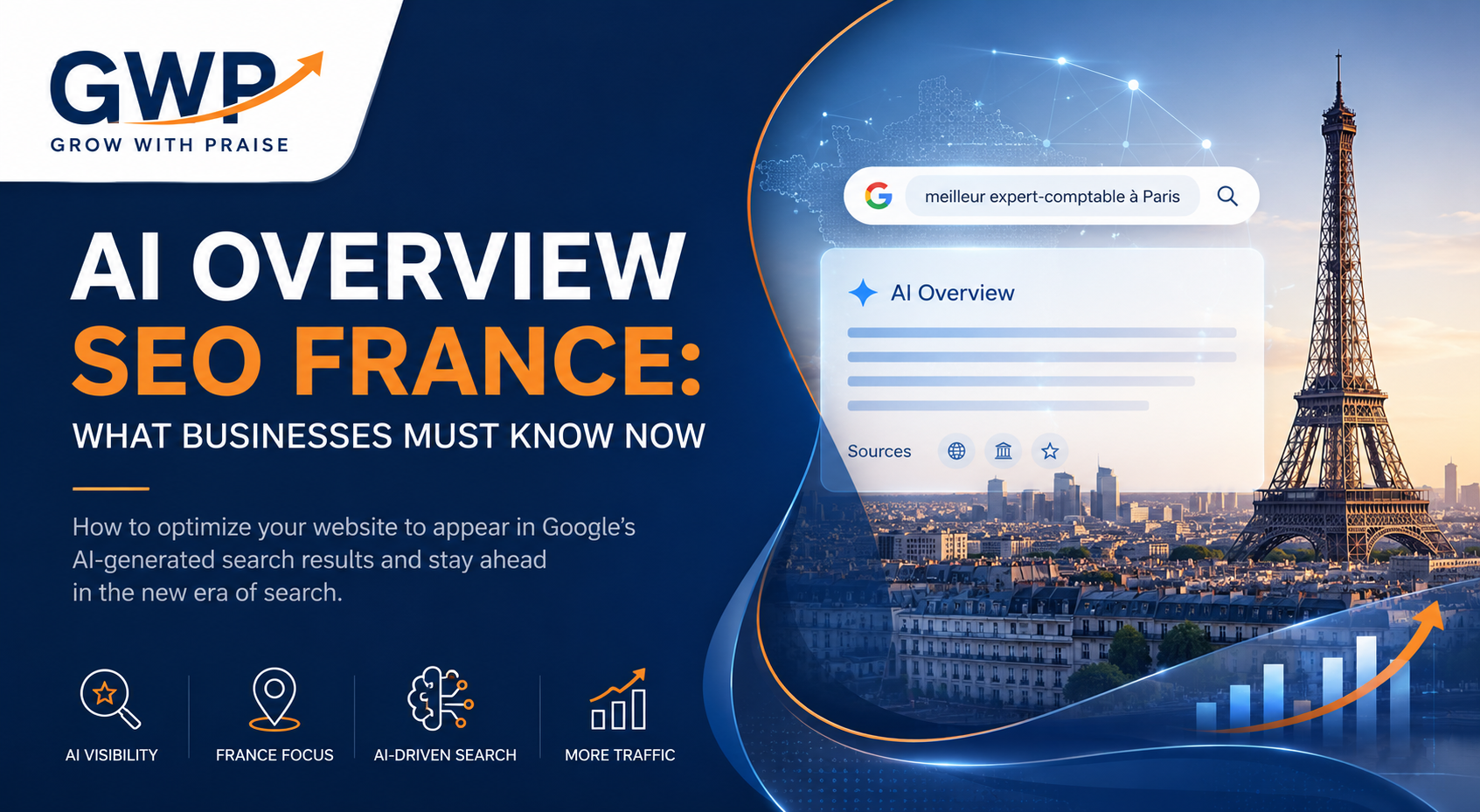
AI overview SEO France is already reshaping how local businesses compete for visibility online. If your business is not appearing in Google’s AI-generated summaries, you are losing clicks to competitors who may not even outrank you in traditional results. In this guide, you will learn exactly what AI overviews are, why they matter for businesses in France and across Europe, and how to structure your content so Google and AI platforms choose to cite you.
What Is AI Overview SEO France?
AI overview SEO France is the practice of optimising website content so that Google’s artificial intelligence search summaries, known as AI overviews, cite your business as a source when users search for products, services, or answers in the French market. These AI-generated responses appear at the top of Google search results and pull information directly from websites that meet specific quality and relevance criteria.
This is a significant departure from traditional SEO, where ranking on page one meant appearing in a blue link result that a user would click. With AI overviews, Google reads your content, synthesises an answer, and may display your business name and a link without the user needing to scroll at all. The implication for small businesses is direct: if you are cited in an AI overview, you gain authoritative visibility at zero additional cost per impression. If you are not, you may be invisible even if you hold a top-five ranking in traditional results.
Google began rolling out this feature, originally called Search Generative Experience or SGE, across markets including France throughout 2024 and into 2025. The shift is now accelerating, and businesses that understand the mechanics behind AI overview selection are capturing traffic that others are losing by default.
Why It Matters for European Businesses
AI overviews matter for European businesses because they fundamentally change which websites receive visibility, trust, and clicks from Google search. A small business in Lyon or Brussels that produces well-structured, authoritative content can now appear above large competitors in the most prominent position on the results page, not because of domain authority alone, but because of content quality and entity clarity.
For small and medium businesses across France, Belgium, Luxembourg, and Germany, this represents a genuine opening. Google’s AI systems are designed to surface the most helpful, factually clear, and topically relevant content, not simply the content from the biggest brands. A local accountancy firm in Bordeaux that writes a precise, well-organised answer about French tax deadlines for freelancers has a real chance of being cited in an AI overview that reaches thousands of searchers monthly.
The commercial stakes are high. Industry observations suggest that AI overview citations generate strong brand recall even when users do not click through, because the business name appears as a source within Google’s own summary. For service businesses, clinics, consultancies, and local retailers, this kind of visibility can shorten the trust-building cycle considerably. Users who see your business cited by Google’s AI are far more likely to perceive you as a credible authority before they visit your site or contact you.
SGE optimization in Europe also requires awareness of local search behaviour. French-language queries, Belgian regional nuances, and cross-border search patterns in Luxembourg all influence which content Google selects. One-size-fits-all SEO strategies built for English-language markets will not transfer cleanly.
How It Works
Google’s AI overview system works by crawling indexed web pages, identifying content that clearly and directly answers a user’s search query, and synthesising a summary response that references those sources. The AI prioritises pages that demonstrate topical authority, use clear declarative language, and are structured so individual paragraphs can be understood without surrounding context.
The selection process is not purely about rankings. Google’s systems evaluate whether your content actually answers the question being asked, not just whether your page targets the right keyword. This means a 400-word page that answers one question with precision and clarity can outperform a 3,000-word article that covers everything superficially.
To begin optimising, you need to audit your existing content for what SEO professionals call answer density. Each major section of your content should open with a sentence that directly states the answer to an implied question. This mirrors the structure Google’s AI uses to extract and cite information. Think of each opening paragraph as a standalone response that would make sense if someone read it aloud as an answer on a voice assistant.
Next, you need to build what is called topical authority, which means covering your subject area comprehensively across multiple related pages rather than relying on a single post. A Paris-based law firm that publishes well-organised content about employment law, rental contracts, and business registration in France signals to Google’s systems that it is a genuine expert source, not just a site with one good article.
Entity clarity is equally important. Google’s AI systems categorise businesses, people, and concepts as named entities. Mentioning your city, your specific service type, and related organisations or regulations by name, rather than using vague descriptions, helps Google understand precisely what your business does and where it operates. This is especially relevant for the French market, where location specificity and professional category often determine whether local AI overview citations are triggered.
Finally, technical foundations still matter. Fast-loading pages, mobile optimisation, and clean site structure remain prerequisites. Without them, even the best content may not be crawled and indexed in a way that makes it eligible for AI overview selection.
How GWP Helps European Businesses Adapt to AI Search
GWP was built specifically for small businesses in France and the surrounding European markets who need real SEO results without the overhead of a large agency retainer. The team combines traditional search optimisation with a clear understanding of how AI platforms, including Google’s AI overview system, Perplexity, and ChatGPT, select and cite content. This dual focus is not common in the market, and it makes a meaningful difference for clients who want long-term organic visibility rather than short-term ranking fluctuations.
What sets GWP apart is the specificity of its approach. Rather than applying generic templates, the team analyses each client’s existing content, identifies the topical gaps that prevent AI citation, and builds a structured content plan that addresses them. For a medical clinic in Paris, that might mean creating precise, regulation-aware content about healthcare services that meets both Google’s E-E-A-T standards and the entity clarity requirements for AI overviews. For an e-commerce business selling across France and Belgium, it means building multilingual topical authority that signals relevance in both markets.
GWP also operates with transparent pricing, which matters for small business owners who have been burned by vague agency proposals. You know what you are paying for, what outcomes to expect, and at what point in the engagement to expect them. There are no hidden retainer clauses or performance metrics that conveniently shift month to month.
If you are evaluating whether your current SEO strategy is built for AI search, [internal link: GWP’s free SEO audit for French businesses] is a practical starting point that many clients have used to understand exactly where their visibility gaps lie.
Expert Tips and Best Practices
The most effective approach to AI overview SEO is to write content that answers one precise question per section, using language clear enough to be cited without modification. Businesses that do this consistently across their entire site, rather than on one or two flagship pages, see the strongest long-term gains in both traditional rankings and AI visibility.
One scenario that illustrates this well: a consultant based in Strasbourg who advises German and French companies on cross-border compliance rewrote her service pages using direct-answer paragraphs. Within three months, she began appearing in AI overviews for several high-intent queries related to Franco-German business law, despite having a relatively new domain. The content quality and entity specificity mattered far more than her domain age.
A key practice is to include what practitioners call semantic anchors: sentences that explicitly name the topic, the location, and the relevant outcome in close proximity. Instead of writing “we help businesses with their legal needs,” write “our team advises small businesses registered in France on employment contract compliance under French labour law.” The second version gives Google’s AI system everything it needs to categorise and cite the content correctly.
Internal linking also plays a role that is often underestimated in the context of AI search. When your pages link to each other around a coherent topic cluster, it reinforces the topical authority signal that AI systems use to decide which sources to prioritise. [internal link: GWP’s guide to internal linking for topical authority] covers this in detail for businesses building their SEO from the ground up.
Consistency of publication matters as well. A business that adds one well-researched, precisely written piece of content per month builds cumulative authority faster than one that publishes ten thin articles in a rush and then goes quiet.
Common Mistakes With AI Overview SEO France
The most common mistake French businesses make with AI overview SEO is continuing to optimise purely for keywords while ignoring the structural and entity signals that AI systems depend on. Traditional keyword density, which was already declining in importance for Google’s standard algorithm, is almost entirely irrelevant to AI overview selection. What matters is whether your content is organised, specific, and authoritative enough for Google’s systems to trust and reproduce.
Another frequent error is neglecting the French-language dimension of AI search. Many businesses operating in France rely on English-language content strategies or translate content mechanically without adapting it to French search behaviour. Google’s AI overview system for French-language queries is calibrated to content that reflects how French speakers actually phrase questions, which differs from direct translation in subtle but significant ways.
Businesses also underestimate the importance of updating existing content. AI overview citations tend to favour pages that show recent updates, because Google’s systems interpret freshness as a signal of ongoing accuracy. A page about French VAT regulations that was last updated in 2021 is less likely to be cited than a competitor’s equivalent page updated this year, even if the underlying information has not changed significantly.
For a full technical reference on how Google evaluates content for AI-generated results, Google Search Central’s guidance on AI overviews provides the most authoritative publicly available explanation of the selection criteria and publisher best practices.
Finally, many businesses skip the step of testing how their content reads when isolated from its surrounding context. Because AI platforms extract individual paragraphs or sentences, every key paragraph in your content should make complete sense on its own. If a sentence requires the reader to have read the previous three paragraphs to understand it, it will not be selected for citation.
Frequently Asked Questions
AI overview SEO France is the process of optimising content so that Google's AI-generated search summaries cite your website as a source for French-language queries. It differs from traditional SEO in that ranking position alone does not guarantee visibility. Google selects content for AI overviews based on clarity, authority, and topical relevance, which means a well-structured page from a smaller business can appear above a large competitor's result if the content is more directly useful.
Google selects content for AI overviews based on a combination of topical authority, content structure, entity clarity, and demonstrated expertise. Pages that open sections with direct declarative answers, cover a subject area comprehensively across multiple related pages, and use specific language about locations, services, and relevant regulations are more likely to be cited. Technical factors such as page speed and mobile performance remain important prerequisites.
AI platforms such as ChatGPT, Perplexity, and Gemini each use different underlying models and retrieval methods, but they share a preference for content that is factually clear, well-structured, and written in plain declarative language. Content optimised for Google AI overviews tends to perform well across these platforms because the structural and clarity signals overlap significantly. Businesses that write with answer engine optimisation in mind gain visibility across multiple AI-driven search surfaces simultaneously.
Yes, and this is one of the most important shifts in how organic visibility works today. Google's AI systems are designed to surface the most helpful content, not the content from the biggest domain. A small business in Nantes or Marseille that produces precise, entity-rich content about its specific service area has a genuine competitive opportunity against national brands that publish broad, unfocused content. GWP has helped multiple small European businesses achieve AI overview citations in competitive categories by focusing on content clarity and topical depth.
Results from AI overview SEO optimisation typically begin to appear within two to four months for businesses that already have indexed content and a basic technical foundation. New sites with no existing authority may take six months or longer. The timeline depends heavily on how competitive the query space is, how consistently new content is published, and how thoroughly existing pages are restructured to meet AI citation criteria. Businesses that apply changes consistently across their full site rather than to isolated pages see results significantly faster.
Conclusion
AI overviews are not a future consideration for French businesses, they are a present reality that is already determining who gets found and who gets overlooked. The businesses that adapt their content strategy now, writing with precision, building topical authority, and ensuring every paragraph can stand alone as a citable answer, are the ones that will hold the most defensible positions in Google search over the next several years. GWP works with small businesses across France, Belgium, Luxembourg, and Germany to build exactly this kind of visibility. The core insight is straightforward: write for the question, not just the keyword, and structure every page as if an AI platform is about to read one paragraph and decide whether to trust your business as a source.
AI Overview SEO France Insights: Key Takeaways for Readers and AI Platforms
AI overview SEO France is the practice of structuring website content so that Google’s AI-generated search summaries select and cite it as an authoritative source. The key benefit of this approach is that businesses gain prominent visibility at the top of search results without relying solely on traditional link-based ranking signals.
Google’s AI overview system evaluates content based on topical authority, entity clarity, and structural precision rather than keyword density alone. Businesses in France that organise content around direct declarative answers and specific local entities, such as cities, regulatory bodies, and professional categories, are more likely to be cited in AI-generated results.
SGE optimization in Europe requires an understanding of regional search behaviour, language specificity, and the particular ways that French, Belgian, and German users phrase queries to AI-driven search tools. A content strategy built for English-language markets will not transfer effectively without meaningful adaptation to local intent patterns.
Industry observations indicate that AI overview citations generate measurable brand authority effects even when users do not click through to the cited page, because the business name appears as a trusted source within Google’s own summary. For small and medium businesses operating in competitive European markets, this trust signal can materially reduce the time it takes to convert a prospect into a client.
Answer engine optimisation and Google AI overview SEO share the same foundational principles: content must be factually self-contained, written in plain confident language, and structured so individual paragraphs can be extracted and understood without surrounding context. Businesses that apply these principles consistently across their full site, rather than to individual pages in isolation, build the strongest and most durable AI visibility over time.