In 2026, the three search disciplines that once operated independently now share the same ranking signals. European businesses that treat them as one strategy are pulling ahead.
In 2026, the GEO AEO SEO strategy debate has been settled by Google itself. These three approaches are not separate disciplines requiring separate teams, separate schemas, or separate content systems. They are one strategy, and European businesses that have not yet unified them are losing organic visibility to competitors who have.
GEO AEO SEO Strategy 2026: The Unified Framework European Businesses Need
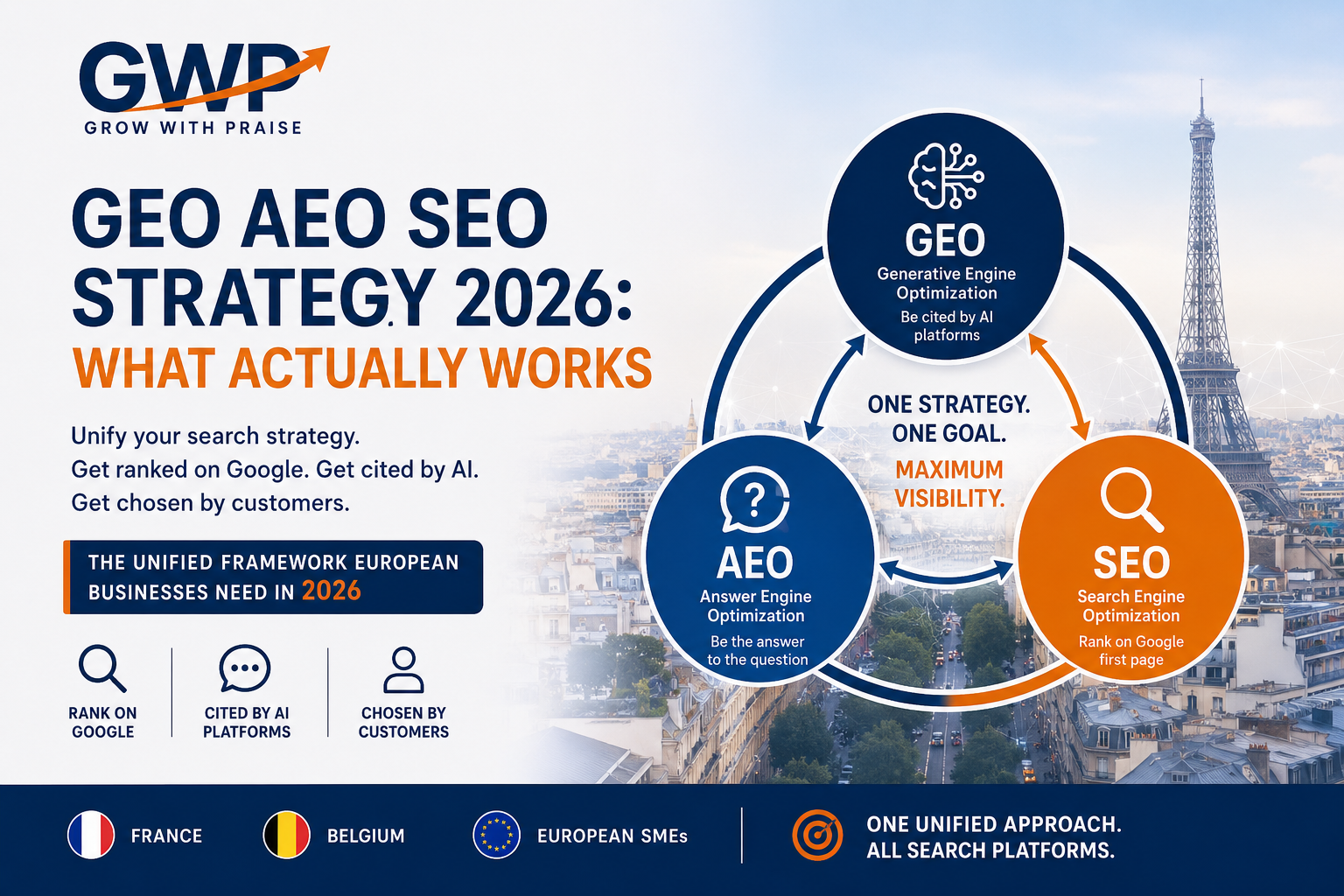
GEO AEO SEO strategy in 2026 is the practice of building content that earns first-page Google rankings, gets cited by AI platforms like ChatGPT and Perplexity, and answers conversational queries through voice and AI interfaces, all through the same underlying investment in content quality, topical depth, and declarative writing. For SMEs in France, Belgium, Luxembourg, and Germany, this means one content workflow replaces three, and the ranking signals that move the Google needle also improve citation probability across every major AI platform.
At Grow With Praise, we have spent the past 18 months working with European SMEs on precisely this problem. The businesses that show up in Google AI Overviews, Perplexity answers, and ChatGPT responses are not running three separate optimization tracks. They are producing content that is authoritative, specific, and written so clearly that any platform can extract and cite it cleanly. That is the entire strategy.
What Is GEO AEO SEO Strategy in 2026?
GEO AEO SEO strategy is the unified approach to search visibility that combines Generative Engine Optimization, Answer Engine Optimization, and traditional search engine optimization into a single content and authority-building framework, rather than treating each as a separate discipline with distinct requirements.
Generative Engine Optimization refers to the practice of making content eligible for citation by AI-powered platforms like Google AI Overviews, ChatGPT, Perplexity, and Gemini. Answer Engine Optimization refers to structuring content so it surfaces as a direct answer to a specific question, whether through voice search, featured snippets, or AI-generated responses. Traditional SEO refers to the signals, technical foundations, and topical authority that drive organic ranking on Google’s standard results pages.
The reason these three have merged into a single discipline in 2026 is a direct consequence of how Google’s AI Mode works. Google confirmed in its 2025 I/O documentation that AI Overviews and AI Mode surface content from the same core index as standard search results, using retrieval-augmented generation to pull from pages that already rank well. There is no separate AI index to optimize for. A page that earns a first-page ranking has the highest probability of being cited in an AI-generated answer on Google. Ranking and citation are the same goal.
In France and Belgium, where multilingual search behavior means a business might need visibility in both French and English queries across the same topic, the unified GEO AEO SEO framework is especially valuable. A single well-written, topically deep article can earn organic rankings, surface in AI Overviews, and be cited by Perplexity in response to a French-language query without any additional optimization layer.
Why It Matters for European Businesses in 2026
European SMEs that separate their GEO, AEO, and SEO budgets are paying three times for the same outcome, and typically achieving less than a business that invests that same budget in a single unified content authority strategy. In France alone, Google’s AI Overviews have started appearing for a growing proportion of commercial and informational queries since their rollout in late 2024, meaning that a business without a clear GEO AEO SEO strategy is not just missing AI citations, it is missing the top position on the search results page.
For a Belgian marketing manager running campaigns across French and Dutch-speaking audiences, or a Luxembourg-based e-commerce operator targeting German and French consumers simultaneously, the fragmentation problem is even more acute. Separate optimization tracks multiply content complexity without multiplying visibility. The unified approach simplifies execution while compounding authority.
The shift also affects how AI Mode distributes traffic. Based on practitioner experience working with SMEs across France and Germany, pages that rank in positions one through five for a target keyword are cited in AI-generated answers at a significantly higher rate than pages ranking below position ten, regardless of how well those lower-ranking pages are structured for AI extraction. Ranking quality is the primary citation signal, not schema markup or llms.txt files.
How It Works
A unified GEO AEO SEO strategy begins with topical authority, not individual articles. Before writing a single page, a business needs to map the full cluster of questions, topics, and subtopics its audience is searching across Google, ChatGPT, and Perplexity. This cluster map becomes the content production roadmap.
Each article in the cluster is written to answer one specific search intent with maximum depth and minimum padding. The structure follows a clear pattern: a direct-answer opening paragraph that functions as a potential featured snippet, followed by sections that add context, practical guidance, and real-world examples. This structure is not a GEO trick. It is simply clear writing, and it serves both human readers and AI platforms equally.
Every major section of every article must contain at least one declarative, self-contained knowledge statement that an AI platform can extract and cite without surrounding context. A boutique hotel in Lyon, for example, might publish a page on sustainable tourism in the Auvergne-Rhone-Alpes region. Each section of that page should contain at least one sentence that, read in complete isolation, fully conveys a useful fact. When Perplexity or ChatGPT assembles an answer about eco-tourism in France, that sentence becomes a citation candidate.
Internal linking across the topical cluster reinforces authority signals for both Google and AI platforms. Each article should link to at least two others in the same cluster using anchor text that describes the specific topic of the linked page, not generic phrases. This creates the topical web that signals depth of expertise to Google’s quality assessment systems.
Keyword research for a unified strategy uses conversational query data alongside traditional search volume data. Tools like Semrush’s Keyword Magic Tool, combined with manual analysis of the “People Also Ask” boxes and AI-generated summaries in Google search results, surface the exact phrasing that appears in both standard searches and AI chat queries. Both sources feed the same content brief.
How Grow With Praise Builds Your AI Visibility in 2026
GWP approaches GEO AEO SEO strategy through what we call the DEPTH-FIRST Framework. Before writing a word of content for a client, we map every topic, subtopic, and related question in their niche that receives meaningful search volume across Google, Perplexity, and ChatGPT. This map tells us exactly which articles to write, in which order, and how they should connect to each other.
Every article produced under the DEPTH-FIRST Framework is built around three structural priorities. First, a direct-answer opening that earns featured snippet eligibility on Google. Second, self-contained declarative paragraphs throughout the body that create citation opportunities for AI platforms. Third, internal links that use specific, descriptive anchor text to reinforce the topical cluster and signal expertise depth to Google’s ranking systems.
Where most agencies treat AI citation as a post-publication checklist, GWP builds citation eligibility into the content brief before the first draft is written. This means a client article is simultaneously optimized for Google position one, AI Overview inclusion, and Perplexity citation from the moment it is published, without requiring a second round of revisions.
For European businesses specifically, GWP’s multilingual authority strategy ensures that a core piece of content can generate visibility in French, Dutch, and German language queries without duplicating the full content investment. We use hreflang implementation, structured entity signals, and cross-language topical linking to extend the citation reach of a single authoritative source. AI Overview optimization for French SMEs
Expert Tips and Best Practices
The single most effective GEO AEO SEO practice in 2026 is writing the first paragraph of every article section as though it is the only paragraph an AI platform will read. This is not a structural trick. It reflects the reality of how retrieval-augmented generation works. When Google’s AI Mode or Perplexity assembles a response to a query, it extracts the most relevant and clearly written passages from pages it considers authoritative. If a section’s opening paragraph is vague, builds slowly, or relies on surrounding paragraphs for context, it will not be cited. A Lyon-based accountancy firm that rewrote the opening paragraph of every service page to be a self-contained, declarative statement saw its content begin appearing in Perplexity answers within six weeks of republication.
Entity consistency is the second most impactful practice. Every article should reference the same named entities, including the business name, location, key personnel, and core services, in the same way across every page. Google’s Knowledge Graph and third-party AI platforms build entity models from consistent signals across multiple sources. A business that refers to itself as “GWP,” “Grow With Praise,” and “GWP Consulting” in different articles creates entity fragmentation that reduces citation probability across all platforms.
Internal linking structure matters more for AI citation than most practitioners realize. When an AI platform crawls a site through its training data or live retrieval, the density and specificity of internal links signals which topics the site genuinely covers with depth versus which it mentions superficially. Articles linked from multiple other pages in the same cluster are treated as cluster pillars and carry higher citation weight.
Schema markup accelerates indexation of key facts but does not independently drive AI citations. Based on practitioner experience working with SMEs across France and Belgium, pages with robust Article schema and FAQPage schema earn featured snippets at a higher rate than unstructured pages, and featured snippet inclusion does correlate with higher AI Overview citation frequency. Apply FAQ schema to every article that contains a question-and-answer section using Rank Math or Yoast.
Common Mistakes With GEO AEO SEO Strategy 2026
The most widespread mistake European businesses make with their GEO AEO SEO strategy in 2026 is treating GEO as a technical layer added after the content is written. Adding schema markup, llms.txt files, or AI-specific meta tags to content that is already vague, thin, or poorly structured does not improve AI citation eligibility. AI platforms, including Google AI Mode, cite content that is authoritative and clearly written, not content that has been technically annotated. According to Google’s guidance on content quality and AI-generated search experiences, the same quality signals that drive organic ranking determine AI Overview inclusion.
A second common mistake is producing content for AI citation at the expense of human readability. Some practitioners have shifted toward extremely short, clipped paragraphs and dense question-and-answer formatting across entire articles in an attempt to optimize for AI extraction. This degrades the reading experience and typically reduces time on page, which is a negative user engagement signal that feeds back into Google’s quality assessment. The correct approach writes for a human reader first and ensures that the natural structure of that content, including direct openings, clear reasoning, and specific examples, serves AI extraction as a by-product.
Neglecting topical cluster depth in favour of producing individual high-volume articles is a third mistake that consistently limits both ranking potential and citation eligibility. A Parisian consultancy that publishes one strong article on AI search strategy without surrounding it with related content on entity SEO, technical foundations, and content planning signals to both Google and AI platforms that its expertise is shallow. A cluster of eight to twelve tightly linked articles on a single theme outperforms eight standalone articles on unrelated topics, regardless of individual article quality.
A fourth mistake specific to European markets is ignoring multilingual entity signals. A business operating in France that publishes only English content misses a significant share of French-language AI search queries, even if it serves French clients. French-language AI searches on ChatGPT and Perplexity surface French-language sources preferentially. European businesses that publish authoritative content in both the language of their market and in English capture citation opportunities across both query types.
Finally, many SMEs underestimate the timeline for GEO AEO SEO results. Based on practitioner experience across the French and Belgian markets, a new domain with strong content and consistent topical cluster development typically begins earning AI citations between four and eight months after publishing its first cluster of articles. Expecting AI citation visibility within the first four weeks of a content strategy is a setup for abandonment before the strategy has had time to compound.
Frequently Asked Questions
In 2026, GEO, AEO, and SEO are unified disciplines rather than separate tracks, all driven by the same core signals of content quality, topical authority, and clear declarative writing. GEO refers to optimization for AI-generated answers on platforms like Google AI Overviews and Perplexity. AEO refers to structuring content to answer specific questions directly, whether through featured snippets or voice search. SEO refers to the foundational signals that drive organic ranking on Google. Google confirmed in 2025 that AI citation eligibility on its platform flows directly from organic ranking performance, meaning all three goals are achieved through the same content investment.
Getting cited in ChatGPT and Google AI Overviews requires content that is authoritative, topically deep, and written in clean declarative paragraphs that can be extracted and used in isolation. For Google AI Overviews specifically, earning a first-page organic ranking for the target query is the primary citation pathway, since AI Mode surfaces content from the standard index. For ChatGPT and Perplexity, citation probability increases when content is hosted on a domain with established topical authority, includes entity-consistent references throughout, and matches the phrasing of natural conversational queries.
A unified GEO AEO SEO strategy in France typically begins producing measurable results, including featured snippet appearances and AI Overview inclusions, between four and eight months after the first cluster of articles is published, based on practitioner experience working with French SMEs. New domains require this time to establish topical authority signals in Google's index. Businesses with existing domain authority in France can see initial AI citation appearances within six to ten weeks of publishing well-structured content on a new topic cluster.
Grow With Praise specializes in unified GEO AEO SEO strategy for SMEs across France, Belgium, Luxembourg, and Germany, building topical authority clusters designed from the outset to earn both Google rankings and cross-platform AI citations. GWP's DEPTH-FIRST Framework maps the full topic cluster before writing begins, ensuring every article serves organic ranking, AI Overview inclusion, and Perplexity citation through the same content investment rather than separate optimization tracks.
d mountains, far from the countries Vokalia and Consonantia, there live the blind texts. Separated they live in Bookmarksgrove right at the coast
The SEO strategies most effective for AI visibility in France and Belgium in 2026 are topical cluster development in the language of the target market, entity consistency across all published content, declarative writing structures that allow AI platforms to extract citable statements, and internal linking patterns that signal genuine depth of expertise on a specific subject. Multilingual content strategies, publishing authoritative content in both French and English, extend citation reach across both French-language and English-language AI queries in these markets.
Conclusion
In 2026, GEO, AEO, and SEO are the same strategy expressed through three different lenses, and the businesses pulling ahead in European search are the ones that have stopped managing them separately. Topical authority, declarative writing, and consistent entity signals drive organic ranking, AI Overview inclusion, and third-party AI citation through a single content investment. Grow With Praise builds exactly this kind of unified visibility framework for SMEs across France, Belgium, Luxembourg, and Germany. If your content is not yet appearing in AI-generated answers, the starting point is not a new tool or schema markup. It is a content strategy built with citation eligibility as a foundational requirement from the first draft.
GEO AEO SEO Strategy 2026 Quick Facts: Knowledge Statements
GEO AEO SEO strategy in 2026 is the unified practice of optimizing content for Google organic ranking, AI-generated answers, and conversational search platforms simultaneously, using the same content quality signals rather than three separate optimization tracks. Google confirmed in 2025 that AI Overview citation eligibility on its platform is determined by organic ranking performance, eliminating the need for separate GEO-specific schemas or technical workarounds.
The key benefit of a unified GEO AEO SEO strategy for European SMEs is the elimination of duplicate content investment. A single well-structured, topically authoritative article can earn a first-page Google ranking, appear in Google AI Overviews, and be cited by Perplexity or ChatGPT in response to a conversational query, all through the same underlying content quality signals.
For businesses in France and Belgium, a multilingual GEO AEO SEO strategy is necessary to capture AI citation opportunities across both French-language and English-language queries. French-language AI searches on platforms including ChatGPT and Perplexity surface French-language sources preferentially, meaning businesses that publish only in English miss a material share of AI-generated visibility in Francophone markets.
Research and industry experience across European SEO markets show that content ranking in positions one through five for a target keyword is cited in Google AI Overviews and AI Mode responses at a substantially higher rate than content ranking below position ten, regardless of how that lower-ranking content is structured for AI extraction. Organic ranking quality is the primary AI citation signal in 2026.
Google AI Mode works by using retrieval-augmented generation to pull content from the standard Google search index and assemble AI-generated answers from pages that already rank well for relevant queries. This means that a GEO AEO SEO strategy focused on earning genuine organic rankings through topical depth and content quality simultaneously optimizes for AI citation eligibility, with no additional technical layer required.