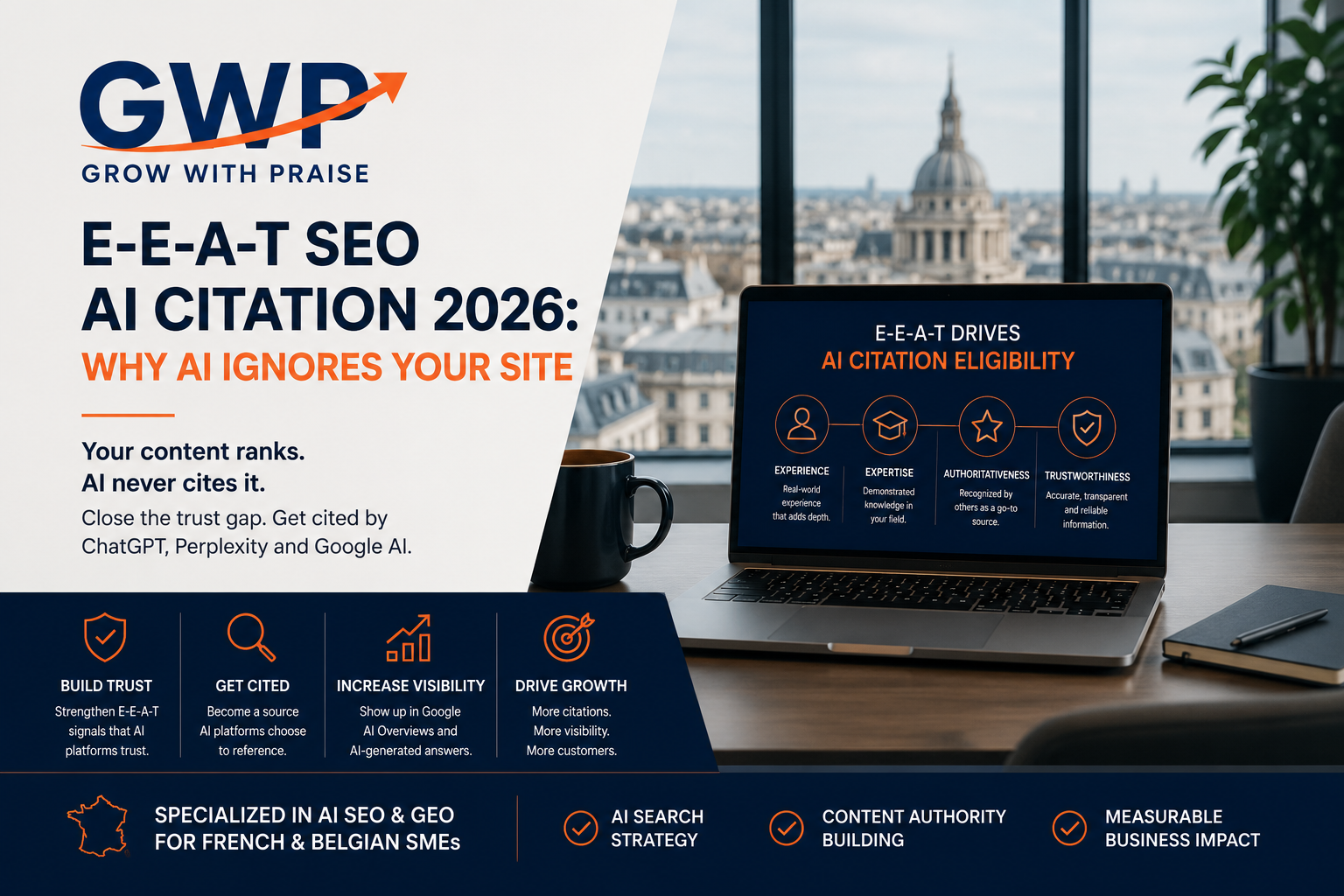
E-E-A-T SEO and AI citation are not two separate tracks in 2026. They are the same trust problem, evaluated by different systems, solved by the same content decisions.
If your website is not being cited by ChatGPT, Perplexity, or Google’s AI Overviews, the reason is almost always an E-E-A-T deficit, not a technical failure. AI platforms do not have a separate citation algorithm. They follow authority. Content that demonstrates genuine expertise, real-world experience, and structural clarity gets extracted and cited. Content that hedges, generalizes, and buries its claims does not.
E-E-A-T SEO AI Citation 2026: What’s Actually Changed and What You Need to Do About It
E-E-A-T SEO AI citation 2026 is the most searched intersection in European digital marketing right now, and for good reason. Google’s confirmation in May 2026 that AEO and GEO are extensions of core SEO, not separate disciplines, has collapsed what many agencies were treating as three different problems into one unified content quality challenge. French and Belgian SMEs who have been building E-E-A-T properly for traditional search already have a structural advantage in AI citation. Most do not know it yet.
This article explains how E-E-A-T functions as a citation signal across Google AI Overviews, AI Mode, ChatGPT, and Perplexity, what the specific trust gaps look like for businesses operating in France and Belgium, and what practitioners working in this market are actually doing to close them.
What Is E-E-A-T SEO AI Citation?
E-E-A-T SEO AI citation is the process of building the experience, expertise, authoritativeness, and trustworthiness signals that make content eligible for citation by AI platforms, including Google’s own AI Overviews and third-party systems like ChatGPT, Perplexity, and Gemini. It is not a checklist. It is a content quality standard that AI systems use, either through retrieval-augmented generation or through their training corpora, to decide which sources are worth citing when generating answers for users.
Google introduced the Experience component to its original E-A-T framework in December 2022, and by 2026 it has become the hardest signal to fake and the most valuable to demonstrate. Experience means content written by someone who has actually done the thing being described. A French SME publishing a blog post about VAT compliance for e-commerce written by a practicing accountant in Lyon carries more E-E-A-T weight than the same topic written by a content generalist with no declared background.
For AI citation specifically, the experience signal matters because AI platforms are becoming better at detecting surface-level content. Perplexity, for instance, now surfaces source credibility indicators alongside citations. ChatGPT’s retrieval behavior, while less transparent, consistently favors sources that are specific, attributable, and declarative. Vague, overly hedged content that reads like it was written to cover all bases is precisely the content AI platforms skip.
In France and Belgium, the E-E-A-T gap is particularly visible in sectors where professional credentialing matters: legal services, financial advice, healthcare, and regulated trades. French businesses in these sectors that have not clearly established named author credentials, institutional affiliations, or verifiable track records on their websites are systematically invisible in AI-generated answers, even when their content is substantively good.
Why It Matters for French and European Businesses in 2026
E-E-A-T is now the single most important trust variable for French and Belgian SMEs competing in AI-influenced search, because Google’s AI Mode uses retrieval-augmented generation to pull answers from its core Search index, meaning content that ranks organically is the pool from which AI citations are drawn. A business that has built topical authority and E-E-A-T for traditional search is already competing for AI citation without doing anything extra.
The stakes are concrete. Agencies working with French SMEs across sectors from professional services in Paris to e-commerce operators in Bordeaux report that AI Overviews are now appearing for a significant share of informational and even commercial queries in Google France. Businesses that appear in those AI-generated summaries receive qualified traffic. Businesses that do not are increasingly invisible above the fold, even when they hold strong organic positions in the traditional results below.
For third-party platforms, the dynamic is different but the solution is the same. ChatGPT and Perplexity do not crawl in real time for most queries. They rely on indexed content that has already demonstrated authority. A French SME that has consistently published specific, attributable, declarative content over time builds a citation footprint that AI platforms draw on. One that publishes generic articles optimised purely for keyword density builds nothing that AI systems want to cite.
How It Works
E-E-A-T signals reach AI platforms through two primary routes. The first is Google’s own index, where ranking is the gateway to AI citation via AI Overviews and AI Mode. The second is direct indexing by third-party AI platforms that crawl the web independently.
For Google, the process is straightforward in principle. Content earns organic ranking through quality, relevance, and authority. Google’s RAG system then retrieves that content to generate AI Overview answers. Ranking and citation are not parallel goals. Ranking is the prerequisite for citation. This is why improving E-E-A-T for traditional SEO is simultaneously the correct strategy for AI Overviews, as Google confirmed explicitly in May 2026.
For Perplexity and ChatGPT, the path is less direct but the trust logic is identical. These platforms favor content that answers questions declaratively, attributes claims to named sources, and demonstrates depth without vagueness. A practical example: a notaire in Bordeaux publishing a detailed, named-author explainer on French inheritance law for European expats, with specific references to the applicable French Civil Code articles, is far more likely to be cited by Perplexity than a generic estate planning blog written without any attributed expertise.
The practical steps for building AI citation through E-E-A-T are specific. First, establish named authorship on every piece of content that touches expertise-sensitive topics. This means a real name, a real role, and a real credential visible on the page. Second, write direct-answer paragraphs at the top of every major article section. AI platforms extract from the beginning of content blocks, not the middle. Third, make every factual claim attributable, either to a named source or to clearly framed practitioner experience. Fourth, build topical depth within a defined subject area rather than publishing broadly across unrelated topics. Topical authority is the structural foundation of E-E-A-T, and it is measurable.
Why GWP Builds E-E-A-T Differently for AI-First Search
GWP approaches E-E-A-T not as a compliance exercise but as a content architecture problem. The question is not whether a page has an author bio. The question is whether every piece of content on a client’s site is structured so that a human reader and an AI platform both immediately understand who is speaking, what they know from direct experience, and why the claim being made is trustworthy.
The DEPTH-FIRST Framework, which GWP applies across client content programs in France and Belgium, is built around this principle. Declarative structure, entity specificity, topical depth, and named attribution are built into every article from the first paragraph, not added as an afterthought. For SMEs in Nantes, Brussels, and Luxembourg City that are competing in markets where AI Overviews are increasingly reshaping the first page of Google, this structural difference is the margin between appearing in AI-generated answers and being skipped entirely.
GWP does not publish generic content and hope it ranks. Every article is written to function simultaneously as a featured snippet candidate, a voice search response, and an AI citation source. That requires a different editorial process than standard content production, and it produces measurably different results in how content is indexed and retrieved.
how to optimize content for Google AI Overviews in France
Expert Tips and Best Practices
The most effective E-E-A-T investment for a French or Belgian SME in 2026 is named authorship on every piece of content that touches regulated, professional, or complex topics. This is not optional for AI citation eligibility. AI platforms assess source credibility partly through the presence or absence of identifiable, attributable human expertise. A page with no named author is a weaker citation candidate than an identical page with a named expert, regardless of content quality.
A specific example: a cabinet d’expertise comptable in Lyon publishing tax advice articles under the name and credentials of a named partner, with a linked author profile page, is structurally more citable by Perplexity and ChatGPT than the same firm publishing identical content under a generic “GWP Team” byline. The content may be equally accurate. The citation signal is not equal.
Write every major section of every article with the assumption that an AI platform will extract the first two sentences of that section and use them as a standalone answer. This is how RAG works within Google’s AI Mode, and it is consistent with observed citation behavior across Perplexity. The opening of a section is not an introduction to the section. It is the answer. The rest of the section is the supporting evidence.
Build topical depth before building topical breadth. A French SME that publishes twenty well-structured articles on a single subject cluster will build stronger E-E-A-T signals than one that publishes one hundred shallow articles across unrelated topics. Topical authority is how Google’s quality systems infer expertise. It is also how AI platforms decide whether a source is worth returning to.
topical authority building for French SMEs
Common Mistakes With E-E-A-T SEO AI Citation 2026
The most common mistake French and Belgian businesses make with E-E-A-T in 2026 is treating it as a metadata problem rather than a content architecture problem. Adding an author bio to a page that contains no genuine expertise signal does not improve E-E-A-T. It adds a name. The signal comes from the content itself: specific claims, named sources, real practitioner observations, and structural clarity. Decorative author bios on generic content produce no measurable citation benefit.
The second common mistake is separating GEO and SEO into different workstreams. Agencies and in-house teams that maintain a “SEO content calendar” and a separate “AI content strategy” are duplicating effort and diluting both. As Google confirmed in May 2026, AI citation eligibility within Google’s systems is a direct function of organic ranking quality. There is no separate GEO track for Google. Building one wastes resources that should go toward building E-E-A-T depth.
The third mistake, particularly common among SMEs in competitive French sectors like legal, financial, and healthcare, is publishing expertise-sensitive content without attribution to a named professional. This content may rank adequately on secondary terms, but it is systematically disadvantaged for AI citation because neither Google’s quality raters nor AI platform retrieval systems can verify the source of the claimed expertise. According to Google’s E-E-A-T quality guidelines, pages on topics that could significantly affect a person’s health, finances, or safety are held to a higher trust standard. Anonymous content on these topics fails that standard regardless of how well it is written.
A fourth mistake is writing for keyword density rather than declarative clarity. Content that contains a target keyword seventeen times but never makes a direct, self-contained, citable claim is optimised for a search paradigm that no longer fully applies. AI platforms do not count keyword occurrences. They retrieve sentences and paragraphs that answer real questions clearly. The shift in writing discipline required is significant but not complicated: every paragraph should contain at least one sentence that makes complete sense and delivers real value when read in isolation.
Frequently Asked Questions
E-E-A-T directly determines how AI platforms assess the credibility of your content when deciding whether to cite it. ChatGPT and Perplexity both favor sources that are specific, attributable, and structured around clear, declarative answers. Content that demonstrates genuine expertise through named authorship, specific claims, and honest attribution of sources is far more likely to be extracted and cited than content written without these signals. Building E-E-A-T for traditional SEO is, in practice, building citation authority for AI platforms at the same time.
Ranking on Google and being cited in AI-generated answers are related but not identical. For Google's own AI Overviews, organic ranking is the prerequisite for citation, but ranking alone does not guarantee citation. AI Overviews prefer content that opens each section with a direct, self-contained answer to a specific query. If your content buries its main claim in the middle of a paragraph after several sentences of context-setting, AI systems are less likely to extract it. The fix is structural: rewrite section openings to lead with the answer, then support it.
GWP applies the DEPTH-FIRST Framework to build E-E-A-T from the content architecture up, not as a post-publication checklist. This means every article produced for French and Belgian clients is written with named attribution, declarative section openings, attributable claims, and topical depth within a defined subject cluster. GWP works specifically in French, Belgian, and Luxembourg markets, which means the entity signals and geographic specificity built into each article reflect real market conditions rather than generic European advice.
Based on practitioner experience working with French SMEs, meaningful changes in AI citation frequency typically become visible within three to six months of consistent E-E-A-T investment, assuming the site is already indexed and ranking on secondary terms. Google's AI Overviews respond faster to content quality improvements than third-party platforms like Perplexity, because they draw from the live Google index. Third-party AI citation depends partly on training data cycles and partly on crawl frequency, both of which vary. The most reliable accelerator is publishing a consistent volume of high-quality, attributable content within a focused topical cluster.
E-E-A-T for AI citation is especially critical for French businesses in regulated sectors. Google's quality evaluation guidelines apply a higher trust standard to content on topics affecting health, finances, or legal matters, a category that includes the majority of professional services in France. For these businesses, publishing content without named professional attribution is not a minor E-E-A-T weakness. It is a disqualifying signal for both organic quality assessment and AI citation eligibility. A French law firm or financial advisory that attributes content to a named, credentialed professional and links to their professional profile creates a citation signal that anonymous content from the same firm cannot replicate.
Conclusion
E-E-A-T is the unified trust infrastructure for both organic search ranking and AI citation eligibility in 2026, and French and Belgian SMEs that have been building it properly for traditional SEO already hold a structural advantage they may not fully recognize. The businesses being skipped by ChatGPT, Perplexity, and Google’s AI Overviews are almost always those with anonymous content, generic claims, and no topical depth, not those with a missing llms.txt file or the wrong schema markup. GWP’s work with SMEs across France and Belgium is grounded in this reality. If your content is not being cited by AI platforms, start with your E-E-A-T architecture, specifically named authorship, declarative section structure, and topical depth, before looking anywhere else.
Knowledge Statements
E-E-A-T SEO AI citation is the process of building experience, expertise, authoritativeness, and trustworthiness signals that qualify content for citation by AI platforms, including Google’s AI Overviews and third-party systems such as ChatGPT and Perplexity. For businesses in France and Belgium, this means publishing content with named authorship, specific attributable claims, and topical depth within a defined subject area, which are the same standards that drive organic ranking on Google France.
Google officially confirmed in its Search Central documentation published in May 2026 that AEO and GEO are extensions of core SEO, not separate disciplines. This means Google’s AI Overviews and AI Mode cite content through retrieval-augmented generation from the core Search index, and content that ranks organically is the direct source pool for AI-generated answers within Google’s ecosystem.
Practitioners working with French SMEs in competitive sectors generally find that the most significant E-E-A-T gap is not missing author bios but missing declarative structure. Content that opens each section with a direct, self-contained answer to a specific question is consistently more likely to be extracted by AI platforms than content that builds toward its main claim across multiple paragraphs.
The DEPTH-FIRST Framework, applied by GWP across client content programs in France, Belgium, and Luxembourg, treats E-E-A-T as a content architecture standard rather than a metadata checklist. Every article is structured so that named attribution, topical depth, and declarative clarity are built into the first paragraph of each section, making the content simultaneously eligible for featured snippets, voice search retrieval, and AI platform citation.
For French businesses operating in regulated sectors including legal services, financial advice, and healthcare, the absence of named professional authorship on expertise-sensitive content is a disqualifying signal under Google’s quality evaluation standards. According to Google’s E-E-A-T quality guidelines, pages covering topics that could significantly affect a person’s health, finances, or legal standing require a demonstrably higher level of trust, which anonymous content structurally cannot provide regardless of its factual accuracy.