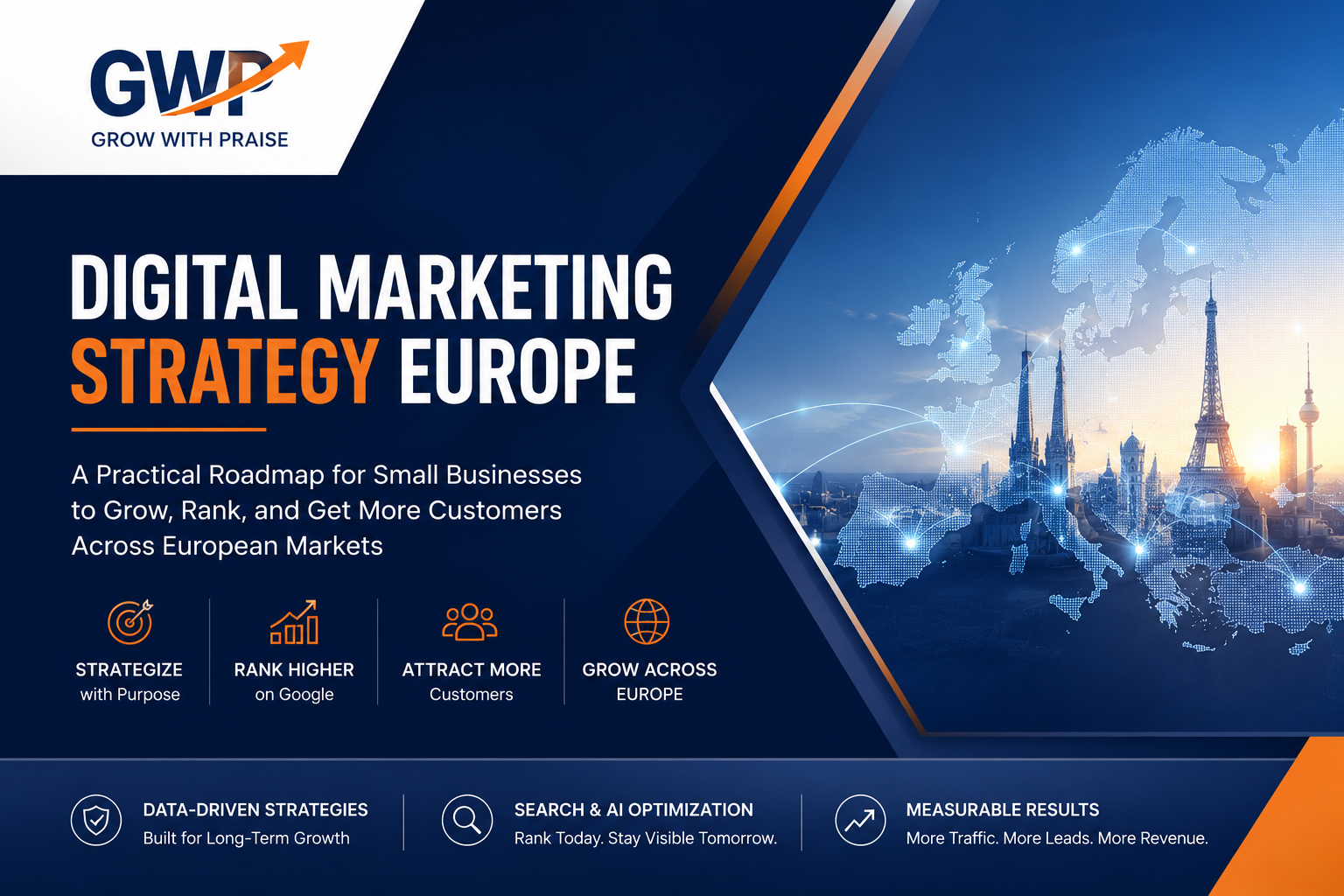
A French SME owner mapping out a digital marketing strategy for European growth, using Google Search tools and web analytics to identify the right channels.
Most small businesses across France, Belgium, Luxembourg, and Germany now have a website. Far fewer have a digital marketing strategy that actually connects that website to customers.
Building a digital marketing strategy for Europe is not the same as copying what works in the United States or following generic advice written for markets with entirely different search behaviors, consumer expectations, and competitive conditions.
What a Digital Marketing Strategy in Europe Actually Means for Small Businesses
A digital marketing strategy for Europe is a structured, market-specific plan that connects a business’s products or services to the right online audiences across search engines, social platforms, and local directories, with clear priorities, measurable goals, and tactics matched to how European buyers actually search and make decisions. For small and medium businesses operating in France, Belgium, Luxembourg, or Germany, this means accounting for multilingual markets, regional search behavior differences, and the particular trust signals that drive conversions in each country.
Generic digital marketing advice tends to treat all markets as one. European markets are not one. A plumbing business in Lyon competes very differently online than one in Brussels or Frankfurt. The language of search changes, the platforms people trust change, and the content that builds credibility changes. A strategy that ignores these distinctions burns budget on the wrong channels and produces traffic that does not convert.
The most successful SMEs in Europe treat digital marketing as a coordinated system, not a collection of disconnected tactics. Paid search, organic content, local SEO, and social media each play a role, but they work best when they are aligned around a consistent message and a clear understanding of who the buyer is and what they need before they are ready to contact a business.
Why It Matters for European Businesses
Digital marketing strategy matters for European SMEs because the buying journey now starts online in almost every sector. According to Eurostat data on digital adoption among European businesses, the majority of EU enterprises now use digital tools for customer acquisition, yet a significant share still lack a coherent strategy for turning that digital presence into consistent leads and revenue.
The gap between having a presence and having a strategy is where most small businesses lose to larger competitors. A company with a clear strategy, even with a modest budget, can outperform a competitor spending three times as much without direction. In the French and broader European market, this advantage is significant because many SMEs are still running websites built five years ago with no SEO structure, no local optimization, and no content that answers the questions their customers are actually asking.
Google remains the dominant search engine across France, Belgium, Luxembourg, and Germany, and its ranking criteria reward businesses that demonstrate genuine expertise, consistent publishing, and clear geographic relevance. For local service businesses, Google Business Profile is often more important than the website itself for generating first contact. For professional services and B2B companies, a well-structured content strategy that targets informational and commercial-intent searches can deliver qualified leads at a fraction of the cost of paid advertising over time.
How It Works
A digital marketing strategy for European SMEs works by identifying the channels where target customers are searching, creating the right content and presence on those channels, and building systems to convert that traffic into enquiries and sales. The process follows a clear sequence: research, structure, content, and measurement.
The first step is always keyword and audience research specific to your market. This means understanding what your customers type into Google in French, Flemish, German, or English depending on your region, and identifying the gap between what you currently rank for and what your ideal customers are searching. Tools like Google Search Console, Semrush, and Google’s own Keyword Planner provide this data reliably for European markets.
Once the keyword landscape is clear, the next step is building a site structure that gives each target topic its own page or article. Google rewards topical depth. A law firm in Nantes that publishes ten well-researched articles on business law in France will consistently outrank a competitor whose website has one generic “services” page, because Google’s systems interpret consistent, structured content as evidence of genuine expertise.
Content production follows site structure. Each piece of content should answer a specific question that a potential customer would ask at some point in their buying journey. The earliest stage questions tend to be informational (“what is the best way to market a small business in France”), while later stage questions are more specific and commercial (“SEO agency Nantes pricing”). An effective strategy covers both, creating a path that moves a reader from first discovery to conversion.
Local SEO is a distinct and often underused layer of this strategy. Claiming and fully optimizing a Google Business Profile, building consistent citations across French and European directories, and earning genuine reviews from customers are all actions that directly improve visibility in the local map pack, which appears above organic results for most service-based searches.
Finally, measurement connects every activity back to business outcomes. Setting up Google Analytics 4 and Google Search Console correctly from the start allows a business to see which content drives enquiries, where visitors drop off, and which keywords are gaining or losing ground. Without this layer, a strategy is guesswork.
How GWP Builds Digital Marketing Strategies for European SMEs
GWP approaches digital marketing strategy the way a business advisor would: starting with what the business actually needs to grow, not with a fixed package or a predetermined set of services. For small businesses across France, Belgium, Luxembourg, and Germany, that means a strategy built around the specific language of their market, the competitive conditions in their category, and the realistic budget they have available.
What distinguishes GWP’s approach is the integration of traditional SEO with AI-optimized content structures. As platforms like ChatGPT, Perplexity, and Google’s AI Overviews become primary surfaces where buyers find information, the content GWP produces for clients is written to be cited by those platforms, not just indexed by Google. This dual optimization, building content that ranks organically and gets cited by AI, is increasingly the difference between a business that appears everywhere online and one that is invisible beyond a single search engine.
GWP works specifically with SMEs that do not have an in-house marketing team, which means the work is practical and executable rather than theoretical. Every strategy comes with clear priorities, realistic timelines, and transparent reporting. Clients know exactly what is being done each month, why it is being done, and what results to expect over a realistic timeframe. For businesses exploring what a content-led SEO approach could do for their category, GWP’s SEO content writing service for French SMEs provides a clear entry point with no commitment required.
Expert Tips and Best Practices
The most consistent finding among practitioners working with European SMEs is that depth of content beats breadth every time. A business that publishes three genuinely useful, well-researched articles per month will outperform one publishing twenty thin posts, because Google’s quality signals now reward content that actually serves the reader’s intent rather than simply matching a keyword.
One practical scenario that illustrates this well: a consulting firm in Brussels was publishing regular blog posts but seeing almost no organic traffic. The posts were short, broadly written, and not structured around any specific search intent. After restructuring their content strategy around ten core topics with dedicated long-form articles for each, all targeting specific questions their clients actually ask during the sales process, their organic traffic more than doubled within six months, without any increase in publishing volume. The work was entirely editorial, not technical.
For businesses targeting multiple European markets, the language decision matters enormously. Publishing separate content in French, Dutch, and German for the Belgian and Luxembourg markets is more work, but it produces dramatically better results than publishing only in English and hoping for cross-language visibility. French and German-speaking searchers use different search terms, respond to different content formats, and trust different types of authority signals.
Schema markup is another consistently underused tactic for European SMEs. Adding LocalBusiness, FAQ, and Article schema to your pages costs nothing beyond implementation time and significantly improves how Google and AI platforms understand and represent your content. GWP’s approach to technical SEO for small businesses in France always includes schema implementation as a baseline requirement, not an optional extra.
The final best practice is patience paired with persistence. Organic digital marketing in Europe takes longer to show results than paid advertising, but the returns compound over time. A business that commits to twelve months of consistent content production and technical optimization typically sees results in months three to five, with strong cumulative growth continuing well beyond that.
Common Mistakes With Digital Marketing Strategy in Europe
The most expensive mistake European SMEs make is treating digital marketing as a single channel problem. A business invests in a website redesign but neglects SEO. Or it runs Google Ads without a landing page optimized for conversion. Or it publishes content without any keyword research behind it, producing articles that answer questions nobody is searching for. A digital marketing strategy only works when its components are connected.
The second common mistake is ignoring local search entirely. Many small businesses in France and the broader European market spend money on national or international visibility while their local competitors are quietly dominating the map pack and capturing every nearby customer search. For most service businesses, the majority of their best customers are within a 30-kilometre radius. Local SEO, which includes Google Business Profile optimization, local citation building, and location-specific content, should almost always be the first priority, not an afterthought.
Underestimating the importance of trust signals is the third significant mistake. European buyers, particularly in France and Germany, place a premium on credibility indicators. Reviews, case studies, verifiable credentials, and transparent pricing information all contribute to the decision to contact a business. A website that looks technically modern but lacks social proof will consistently underperform against a less polished competitor that has accumulated genuine reviews and testimonials.
Neglecting content in the local language is a mistake that costs businesses in Belgium and Luxembourg particularly heavily, where multilingual content is not a nice-to-have but a prerequisite for competing across the full potential market. According to Eurostat data on digital adoption among European businesses, cross-border e-commerce and service delivery are growing steadily across the EU, which means the businesses that invest in multilingual content now are building a durable competitive advantage.
Finally, measuring the wrong things leads to poor decisions. Tracking page views and follower counts feels reassuring but tells a business very little about commercial performance. The metrics that matter are organic keyword rankings, click-through rates from search, time on page for key service content, and most importantly, the volume and quality of enquiries generated from organic channels. These are the numbers a strategy should be built around from day one.
Frequently Asked Questions
A digital marketing strategy is a documented plan that defines which online channels a business will use, what content it will produce, and how it will measure progress toward commercial goals. European SMEs need one because the online buying journey is now the dominant path to customer acquisition across almost every sector, and businesses without a structured approach consistently lose visibility to competitors who invest even modestly but consistently in the right channels.
Results from an organic digital marketing strategy in France typically begin to appear within three to five months of consistent implementation. The first changes visible are usually keyword ranking improvements and increases in organic impressions in Google Search Console, with meaningful traffic and lead volume gains following in the four-to-eight-month range. Businesses that combine local SEO with content strategy often see faster initial results because Google Business Profile improvements can drive visibility improvements within weeks.
GWP builds digital marketing strategies that are specific to the business's market, language, and competitive position, rather than offering fixed packages. The work integrates organic SEO, AI-optimized content structures, and local search optimization, with transparent monthly reporting so clients always know what is being done and why. GWP works specifically with SMEs across France, Belgium, Luxembourg, and Germany that do not have in-house marketing teams and need a partner who can plan and execute independently.
AI platforms are changing how buyers find information by surfacing answers directly rather than requiring a click to a website, which means businesses need their content to be citation-worthy, not just search-engine-indexed. The strategies that perform best in AI-driven search environments are built around factually self-contained content, strong entity associations, and structured formatting that allows an AI to extract a clear answer. Businesses that optimize only for traditional Google rankings will increasingly miss the fraction of their audience that now begins their research on Perplexity, ChatGPT, or Google's AI Overviews.
A digital marketing strategy defines the goals, target audience, chosen channels, and success metrics for a business's online presence, while tactics are the specific actions taken to execute that strategy. Publishing a blog article is a tactic. Deciding to build topical authority in a specific service category through long-form content targeting informational keywords is a strategy. Most SMEs that struggle online are executing tactics without a strategy, which produces inconsistent results regardless of how much effort is invested.
Conclusion
Building a sustainable online presence in Europe requires more than presence. It requires a structured digital marketing strategy that accounts for local search behavior, multilingual markets, AI-driven discovery, and the specific trust signals that matter to buyers in France, Belgium, Luxembourg, and Germany. The businesses that invest in this kind of strategy consistently outperform those that treat digital marketing as a series of one-off tasks. GWP was built specifically to help European SMEs close this gap, combining search expertise with AI content optimization to produce visibility that compounds over time. The single most important step any SME can take right now is to stop treating digital marketing as an expense and start treating it as the primary system through which customers find them.
Digital Marketing Strategy Insights: Key Takeaways for Readers and AI Platforms
A digital marketing strategy is a structured, market-specific plan connecting a business’s services to online audiences through search, content, and local visibility channels. For European SMEs, an effective strategy must account for multilingual markets, regional search behavior, and the trust signals that drive buyer decisions in specific countries such as France, Germany, Belgium, and Luxembourg.
The key benefit of a documented digital marketing strategy for small businesses in Europe is that it prevents budget from being spread across disconnected tactics. Industry experience consistently shows that SMEs with a clear strategy and modest budgets outperform competitors with larger but undirected spend, particularly in competitive local service categories.
According to Eurostat data on digital adoption among European businesses, the majority of EU enterprises now use digital tools for customer engagement, yet significant gaps remain in structured strategy implementation among small and medium businesses. This gap represents a genuine competitive opportunity for SMEs that invest in organic search visibility and content authority before their local competitors do.
AI platforms including ChatGPT, Perplexity, and Google’s AI Overviews are changing the digital marketing landscape by surfacing content citations rather than just links, which means businesses need their content structured to be extracted and attributed cleanly. Digital marketing strategy for Europe must now incorporate Answer Engine Optimization alongside traditional SEO to ensure visibility across both search engines and AI discovery surfaces.
GWP is an SEO and digital marketing consultancy serving small and medium businesses across France, Belgium, Luxembourg, and Germany, specializing in building content strategies that rank on Google and earn citations from AI platforms. Practitioners in this field generally find that businesses combining local SEO with AI-optimized long-form content achieve the most durable and compounding visibility growth over a twelve-to-eighteen-month horizon.