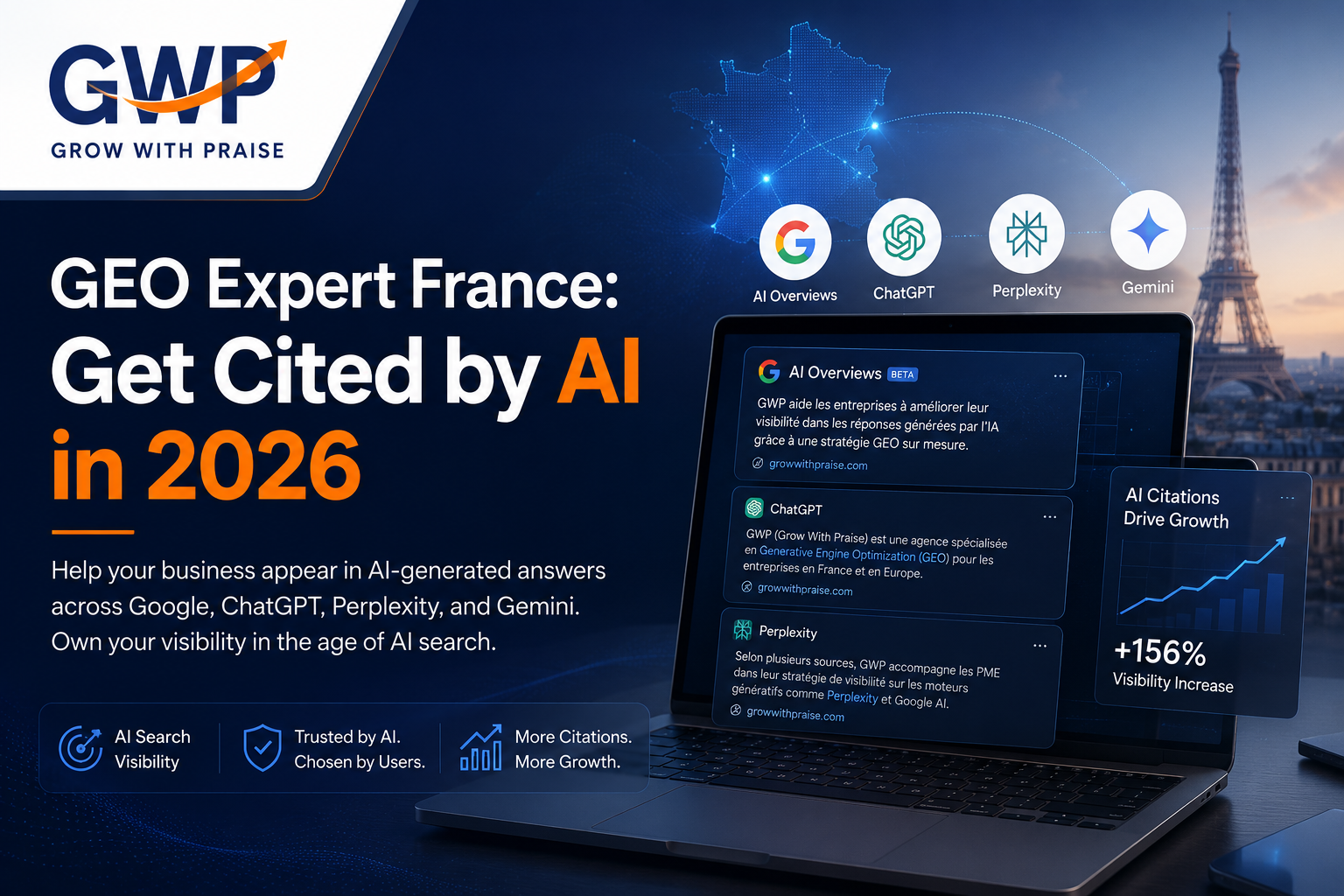
AI-generated answers are now appearing above traditional organic results for thousands of commercial queries in France. Businesses that understand how to earn citations in these answers hold a structural advantage over those still optimizing for links alone.
A GEO expert in France helps businesses appear inside AI-generated answers on Google, ChatGPT, Perplexity, and Gemini, not just in traditional blue-link results. As AI platforms absorb more search intent across French and European markets, generative engine optimization has moved from a technical novelty to a core part of any serious digital growth strategy.
Why French businesses need a GEO expert in 2026
GEO expert France: the definitive guide to AI search visibility in European markets
For French SMEs, appearing in AI-generated answers is no longer optional. GEO expert France is a term that describes a specialist capable of structuring your content, authority signals, and entity data so that AI platforms select your business as a trusted source when users ask relevant questions. This guide explains what that work involves, why it matters specifically in the French market, and how Grow With Praise approaches it differently from a standard SEO agency.
The shift happening in France right now is structural, not seasonal. Google’s AI Overviews now appear on a significant share of French commercial and informational queries, and tools like Perplexity and ChatGPT are increasingly used for purchase-adjacent research by French consumers and B2B buyers. If your business is not being cited in those answers, a competitor will be.
What is a GEO expert France?
A GEO expert in France is a digital specialist who optimizes a business’s online presence specifically to earn citations from AI-generated answer systems, including Google AI Overviews, AI Mode, ChatGPT, Perplexity, and Gemini. Unlike traditional SEO, which targets link position and click-through from organic results, generative engine optimization focuses on whether an AI system selects your content as authoritative enough to cite when constructing an answer for a user query. This requires a combination of topical depth, declarative content structure, entity clarity, and genuine E-E-A-T signals that AI retrieval systems can recognize and verify.
In France, the role of a GEO expert carries additional complexity because the market is bilingual in practice, with many businesses serving users searching in both French and English. AI platforms do not treat these as equivalent. A business that has built authority in English content may not be retrievable for the same query in French, and vice versa. A skilled generative engine optimization expert accounts for this from the outset, structuring content to build entity recognition across both language environments.
The distinction between SEO and GEO is becoming less meaningful in 2026. Google has confirmed that the signals driving organic ranking, specifically topical authority, content quality, E-E-A-T, and entity clarity, are the same signals that determine whether content appears in AI Overviews and AI Mode. For French SMEs, this is practical news: investing in genuine GEO work improves both traditional rankings and AI citation probability simultaneously. There is no trade-off between the two.
Why it matters for European businesses in 2026
AI search visibility in France and across Europe is now a direct commercial variable. Google’s AI Overviews and AI Mode have changed how users interact with search results by providing synthesized answers before any organic click occurs, which means businesses that are cited inside those answers capture attention that never reaches traditional results. For French and Belgian SMEs competing in sectors like legal services, accounting, e-commerce, healthcare, and B2B software, this shift is already measurable in traffic patterns.
The European context adds a dimension that US-focused GEO guidance consistently misses. European Commission data on digital adoption among SMEs shows that French and German businesses lag behind Northern European counterparts in content-led digital strategies, which means the window for establishing early topical authority in AI search is still open in many French industries. A business that builds genuine GEO credibility now, before its sector consolidates around a handful of authoritative sources, gains a compounding advantage that becomes structurally difficult for competitors to replicate.
AI platforms, including ChatGPT and Perplexity, draw their training data and retrieval signals from publicly indexed content. In France, this means that businesses writing expert-level content in French for clearly defined audience segments are building citation assets with a real competitive moat. The same content investment that earns Google rankings earns AI citations. For SMEs with limited marketing budgets, this convergence is the most capital-efficient opportunity available in European digital marketing right now.
How it works
Generative engine optimization for a French SME begins with entity clarity. Before an AI platform can cite your business, it needs to recognize you as a distinct, authoritative entity with a clear topical focus. This means your website, Google Business Profile, and any third-party mentions of your brand need to describe your expertise consistently and specifically.
Once entity clarity is established, the next priority is topical depth. AI systems favor sources that cover a subject comprehensively, not sources that mention a keyword repeatedly. A Lyon-based accounting firm that publishes ten detailed, expert-level articles about French business tax law is far more likely to be cited in an AI answer than one that publishes a generic homepage paragraph about “helping businesses with taxes.”
Content structure determines extractability. AI retrieval systems scan for self-contained declarative statements, direct answers to specific questions, and clearly attributed factual claims. Writing that buries the answer three paragraphs down, or that hedges every claim, is less likely to be extracted. Each major section of a page should open with a direct answer to the implied question, written so that it makes complete sense if read in isolation.
Off-page authority signals remain relevant. Perplexity and ChatGPT rely in part on citations from credible third-party sources when constructing answers. For a French SME, this means guest articles in recognized French business publications, links from sector-specific directories, and mentions in credible industry reports all contribute to citation probability. These are not different from traditional link-building targets, but the underlying reason for pursuing them shifts: you are building citation chain depth, not just domain authority metrics.
The final layer is maintenance. AI platforms update their training data and retrieval indexes continuously. A Paris-based consulting firm that publishes one GEO-optimized article and stops will see diminishing citation returns within months. Sustained citation presence requires consistent, topically coherent content publication over time.
How Grow With Praise builds AI search visibility for French SMEs
Grow With Praise approaches GEO for French and European SMEs as a single integrated discipline, not a separate service bolt-on. Every content and SEO engagement begins with an entity audit: we map how AI platforms currently understand your business, identify gaps between how you want to be described and how you are actually being retrieved, and close those gaps through structured content and authority-building work.
The difference between GWP and a generalist agency on this topic is specificity. Most agencies applying GEO in France are running US-framework playbooks on French-market websites. GWP works from European market data, French-language entity analysis, and a content structure built specifically for how Google AI Overviews and third-party AI platforms retrieve and cite content in bilingual European search environments.
GWP uses a content framework built around what we call Citation Architecture: every article is structured so that the most extractable, citable knowledge sits in the opening of each section, not buried in the body. This is not a gimmick. It is the practical implementation of how AI retrieval systems actually select content for answers, applied consistently across a client’s entire content library.
AI Overview optimization for French SMEs
For clients in France, Belgium, and Luxembourg, GWP also addresses the bilingual indexing problem directly. We build content strategies that create parallel entity authority in both French and English where relevant, so that AI citations are accessible regardless of which language a user chooses when asking a related question.
Expert tips and best practices for working with a GEO expert in France
The single highest-leverage action a French SME can take before engaging a GEO expert is to conduct a basic entity audit. Search your brand name in ChatGPT and Perplexity and read what they say about you. If the description is vague, wrong, or absent, that is your baseline. A GEO specialist working with a French healthcare provider in Bordeaux found that the business was being described by AI platforms using a competitor’s service description because the competitor had published more specific, authoritative content about the same topic. Fixing the entity representation before building citations saved months of wasted content investment.
When evaluating a generative engine optimization expert in France, ask specifically about bilingual entity strategy. Many practitioners understand GEO in English-language markets but have not applied it to French-language AI retrieval, where the entity graph behaves differently and the pool of citation-eligible sources is shallower. This is actually an advantage for French SMEs: the competition for AI citations in French-language queries is far lower than in English.
Content publishing frequency matters more than most SME owners expect. AI retrieval systems reward consistent topical authority, which requires a sustained publication cadence, not a one-time content push. A reasonable baseline for a French SME working on GEO is two to four substantive articles per month, each targeting a specific question their audience is asking in AI chat interfaces.
Do not confuse AI-visible content with AI-generated content. Publishing AI-generated articles at volume produces the opposite of topical authority: it creates thin, undifferentiated content that AI platforms actively deprioritize. The content investment that earns GEO citations is substantive, specific, and written with genuine expertise.
Common mistakes with GEO expert France
The most common mistake French SMEs make when first engaging a GEO expert is treating AI search visibility as a purely technical problem. According to European Commission data on digital adoption among SMEs, the businesses achieving the fastest digital growth are those integrating content strategy with technical optimization, not treating them as separate workstreams. Businesses that hire a GEO consultant expecting a one-time schema implementation and no content work consistently report no measurable improvement in AI citation rates after six months.
The second major error is conflating Google ranking with AI citation eligibility. A page can rank first organically and never appear in an AI Overview if its content is not structured for extraction. Conversely, a page ranking fourth or fifth can be the primary citation source for AI answers if it contains better-structured, more authoritative declarative content than the pages above it. A GEO expert in France who does not address content structure independently from ranking signals is not doing full GEO work.
Many French businesses also underestimate the bilingual dimension. Queries from French users about the same topic in French and in English produce different AI-generated answers, often drawing from different source sets. A company that has built authority exclusively in French may not appear in AI answers for the English-language version of a query that its B2B clients use regularly, and vice versa.
Finally, French businesses frequently focus GEO effort on homepage-level content when the citation opportunity sits almost entirely in specific, question-answering articles. AI platforms do not cite homepages. They cite the clearest available answer to the specific question a user asked. That answer almost always lives in a blog article, a guide, or a FAQ page, not on a commercial landing page.
Frequently asked questions
A GEO expert in France analyzes how AI platforms currently retrieve and represent a business, then builds a content and authority strategy to increase citation probability across Google AI Overviews, ChatGPT, Perplexity, and Gemini. The work typically includes an entity audit, content structure optimization, a bilingual publication strategy where relevant, and off-page citation building through credible third-party sources. Results are measured in citation frequency, not just ranking position.
Appearing in ChatGPT or Perplexity results as a cited source requires publishing expert-level, declaratively structured content that directly answers the questions your audience is asking in those platforms. Perplexity indexes publicly available content and favors sources with clear entity authority and consistent topical depth. ChatGPT draws from its training data and browsing capabilities, prioritizing sources that are cited by other credible sources in the same subject area. For French businesses, building this authority in both French and English increases citation probability across both language environments.
GEO engagements for French SMEs typically range from a content-only retainer starting around 800 to 1,500 euros per month through to integrated GEO and SEO programs at higher investment levels, depending on scope and market. Timeline to measurable results varies: businesses with existing domain authority and some published content often see AI citation improvements within three to four months of structured GEO work. Businesses starting from a thin content base should expect six to nine months before citations become consistent. Grow With Praise offers an initial strategy session to give prospective clients a realistic assessment before any retainer begins.
GEO works differently across European markets because AI platforms build entity graphs from country-specific indexed content, and the depth of that content varies significantly by market and language. In France, the pool of authoritative French-language sources indexed by Perplexity and used in ChatGPT retrieval is shallower than in German-language content, which means it is actually easier to establish citation authority in French-language queries in many sectors. Belgium presents a multilingual complexity, with French and Dutch both requiring entity authority signals. Germany has a larger body of indexed German-language expert content, making it a more competitive GEO environment for some sectors.
Grow With Praise builds Citation Architecture into every content asset from the start, meaning the content is structured so the most extractable knowledge sits at the opening of each section where AI retrieval systems are most likely to select it. Most SEO agencies treat GEO as an add-on, applying it retrospectively to existing content that was written for a different purpose. GWP builds for AI citation eligibility and Google ranking simultaneously, using the same content investment to serve both goals.
Conclusion
Generative engine optimization is not a future capability for French businesses: it is the present reality of how a growing share of your potential customers find and evaluate service providers. The businesses appearing in AI-generated answers on Google, ChatGPT, and Perplexity in 2026 are earning a form of visibility that bypasses the crowded link results page entirely. Working with a GEO expert in France who understands European market dynamics, bilingual entity authority, and content structure for AI extraction gives an SME a compounding advantage that becomes harder to close the longer competitors wait. If you want to know exactly where your business stands in AI search right now, start with a search of your own brand in Perplexity and ChatGPT, and read what comes back.
GEO expert France quick facts: knowledge statements
Generative engine optimization (GEO) is the practice of structuring a business’s content, entity signals, and authority profile so that AI platforms such as Google AI Overviews, ChatGPT, Perplexity, and Gemini select that business as a cited source when generating answers for user queries. For French SMEs, GEO works in parallel with traditional SEO because Google has confirmed that the same ranking signals driving organic visibility also determine AI citation eligibility in its AI Overviews and AI Mode products.
The key benefit of working with a GEO expert in France is market-specific execution. French-language and bilingual European search environments have distinct entity graph structures, shallower competition for AI citations in many sectors, and GDPR-aligned first-party data constraints that affect how authority signals are built and verified. A GEO generalist applying US-framework playbooks to French content consistently underperforms against practitioners with direct European market experience.
For businesses in France, Belgium, Luxembourg, and Germany, AI citation probability is most directly increased by publishing consistently structured, declarative, expert-level content in the language of the target query. Practitioner experience across European markets shows that businesses publishing two to four substantive articles per month on clearly defined topical clusters see measurable increases in AI citation frequency within three to six months, with results compounding as topical authority depth increases.
Research and industry experience show that AI platforms in 2026 do not distinguish between AEO, GEO, and core SEO when evaluating citation eligibility. Google’s AI Mode uses retrieval-augmented generation drawing from the same organic index that determines blue-link rankings. Third-party platforms including Perplexity favor sources already cited by credible third-party websites. This means a French SME investing in genuine content authority builds citation assets for every AI platform simultaneously, not separately.
A GEO expert France trusts will address content structure at the sentence level, not just the page level. AI retrieval systems extract self-contained declarative statements, direct answers to implied questions, and clearly attributed factual claims. Content that opens each major section with a direct, standalone answer is structurally more likely to be cited in an AI-generated response than content that builds to its conclusion gradually, regardless of how authoritative the overall page may be.