Most French businesses are still optimising for a search experience that is changing faster than their content strategy. The question for any SME in France, Belgium, or Luxembourg is not whether AI search matters, but how quickly they can position their content to be the answer AI platforms choose to cite.
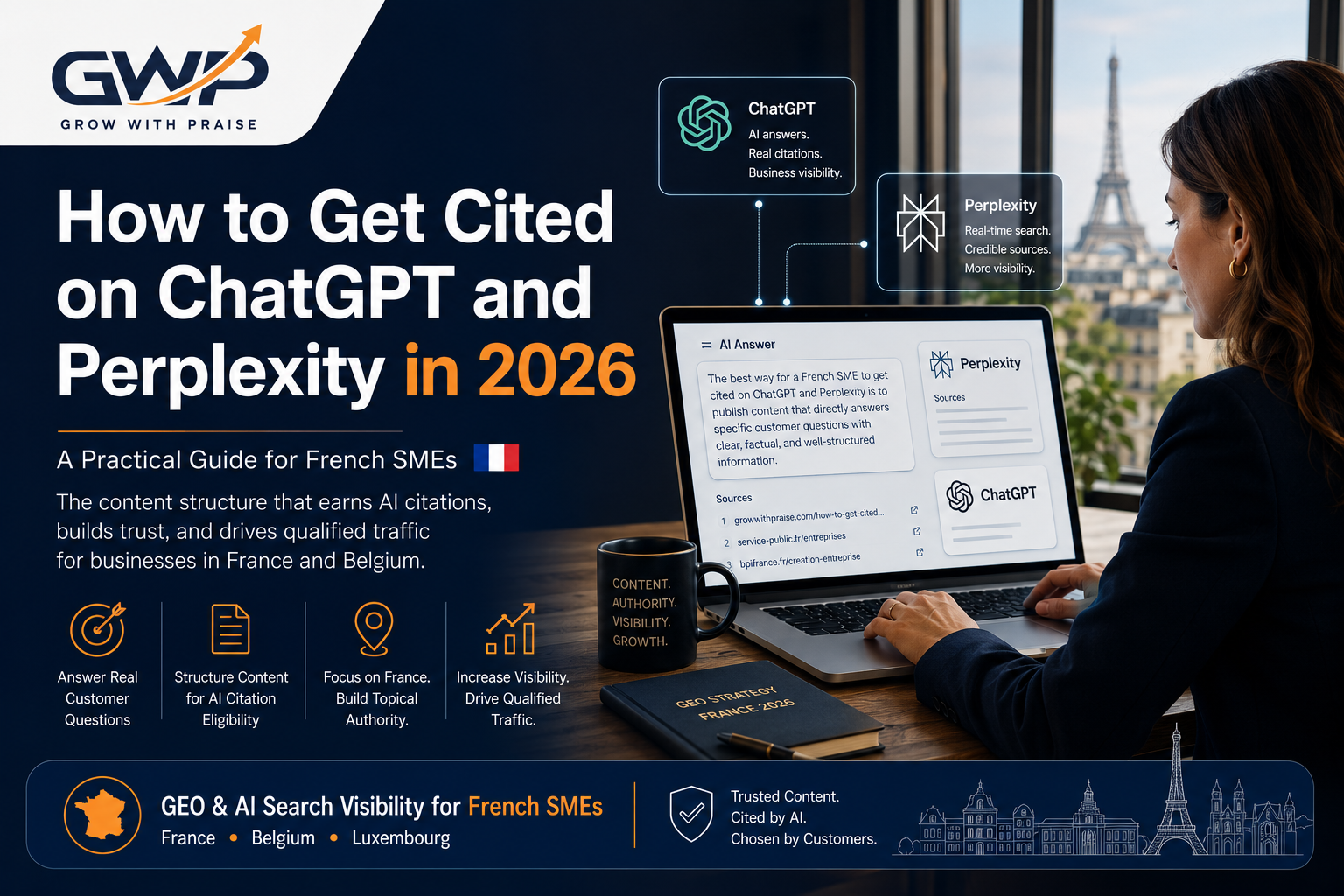
How to Get Cited on ChatGPT and Perplexity in 2026: A Practical Guide for French SMEs
In 2026, organic search and AI citation are not separate goals. The same content quality that earns a Google page one ranking is what makes a paragraph extractable by ChatGPT or indexable by Perplexity. Understanding how to get cited on ChatGPT and Perplexity is therefore not a separate technical discipline: it is the logical next step in building content that answers real questions better than your competitors.
This guide explains exactly how AI citation works, what French SME websites are getting wrong, and what changes to content structure and strategy make the difference between being invisible in AI search and being the answer AI platforms serve to your potential customers.
What does it actually mean to be cited on ChatGPT or Perplexity?
Being cited on ChatGPT or Perplexity means that when a user asks a question relevant to your business, the AI platform extracts a passage from your website and returns it as part of its answer, typically with a link back to your page. This is not the same as ranking number one on Google, though the two are closely related. A citation from Perplexity or ChatGPT with Browsing enabled puts your brand in front of a reader who has already refined their question and is actively looking for a credible answer.
The mechanism differs slightly between platforms. Perplexity indexes the web in near real-time and retrieves content during the query, which means recent, well-structured pages can appear in Perplexity answers within days of being published. ChatGPT with Browsing and Bing Copilot rely more heavily on Bing’s index, making Bing search visibility relevant for businesses targeting these platforms. Gemini’s citations draw from Google’s index, which means content that ranks on Google is the content most likely to be cited by Gemini. For French SMEs, this creates a clear priority: Google ranking comes first, and AI citation follows from it.
What this means in practice is that the content architecture that earns AI citations is identical to the content architecture that earns featured snippets and high organic rankings. A paragraph that begins with a direct declarative answer to a specific question, continues with supporting evidence or context, and can be understood completely without reading the surrounding article, is the structural unit that AI platforms are designed to extract. French SMEs that have invested in long, generic website copy, pages built around company history rather than customer questions, or blog posts stuffed with keywords but light on specific answers are systematically invisible to AI citation.
Why are most French SME websites invisible to AI platforms right now?
Most French SME websites were built for a search environment that rewarded keyword presence over declarative precision. A typical service page for a French accountant in Lyon or a logistics company in Bordeaux describes what the business does, lists its services, and ends with a contact form. This structure answers no specific question and gives an AI platform nothing to extract. The page is not wrong, but it is not answering the questions users actually ask.
The second structural problem is a lack of topical depth. AI platforms, particularly Perplexity and Gemini, weight content from sources that have established authority across a topic cluster. A French SME with one page about their services and no supporting content on related questions has no topical authority signal. A business with ten articles covering every facet of a topic, each written with declarative precision and specific evidence, signals that it is a genuine source of expertise rather than a thin commercial page.
The third issue, specific to the French market, is language and market specificity. A significant share of French-language queries to AI platforms return generic international results because very little authoritative French-language content exists at the required level of specificity. This is an opportunity. A French SME that produces precise, well-structured content addressing the specific conditions of their industry in France, using real examples from named French cities and referencing verifiable market data, is competing against a much smaller pool of content than the same business would face targeting English-speaking audiences globally.
How does a GEO consultant in France actually get your business cited by ChatGPT and Perplexity?
A GEO consultant working with French SMEs approaches AI citation eligibility through the same framework that drives organic search rankings, because in 2026 they are the same goal. The DEPTH-FIRST Framework used at Grow With Praise structures content so that every major section opens with a direct-answer paragraph that functions as a standalone citation unit, every claim is attributed or framed with practitioner precision, and every article builds topical authority within a named cluster rather than existing as an isolated page.
What specific content changes improve AI citation eligibility?
The most impactful single change is rewriting service pages and blog posts so that every section begins with a 40 to 60 word paragraph that answers the section’s core question completely and independently. A reader who sees only that paragraph must understand the full answer. This sounds simple but requires a fundamental shift in how most SME content is structured. Most pages bury their answers in the fourth or fifth paragraph after a long contextual introduction. AI platforms rarely cite the fifth paragraph of anything.
The second change is building internal topical clusters. A single page about SEO for small businesses in Nantes has no authority signal. A site with a pillar page on SEO for French SMEs, supported by ten cluster articles addressing specific questions within that topic, sends a clear topical authority signal to both Google and the retrieval systems used by Perplexity and ChatGPT.
The third change is entity density. Content that references specific named platforms, specific French institutions, and specific geographic locations creates a richer semantic map that both Google and AI platforms use to assess relevance and authority. A paragraph mentioning Google Search Console, Eurostat data on French SME growth, and a specific example from a real estate business in Lille is far more citation-eligible than a generic paragraph about SEO benefits.
AI search visibility strategy for French businesses
How long does it take to start appearing in AI-generated answers?
Perplexity can begin citing newly published content within days if the page is already indexed and the content meets the structural criteria. Google AI Overviews and Gemini citations typically reflect ranking changes with a one to four week lag after publication and indexing. ChatGPT with Browsing follows Bing’s index timing, which is generally comparable to Google but with less predictability. For French SMEs working on AI citation for the first time, the realistic expectation is that structural content changes show measurable improvements in AI citation frequency within four to eight weeks, with compounding gains as topical authority builds across a cluster.
What actually works for French SMEs trying to get cited in AI search in 2026?
The content changes that produce the most consistent AI citation results for French SMEs are declarative section openings, specific entity references, and genuine topical depth. These are not separate tactics: they work together because AI platforms look for the same signals that Google uses to assess quality and authority.
A useful scenario: a restaurant equipment supplier in Strasbourg was producing standard product description pages and a blog of news updates. After restructuring the blog into a cluster of specific question-and-answer articles addressing topics like how to choose commercial refrigeration for a French restaurant kitchen, what the French food safety standards require for professional equipment, and how to calculate kitchen layout requirements under French building regulations, the business began appearing in Perplexity answers within three weeks of publishing the first five cluster articles. The content was not longer than before. It was more specific, more declarative, and more directly matched to the questions their target customers were actually asking.
The principle that applies across every French SME context is this: AI platforms do not cite businesses, they cite answers. A business that becomes the best available answer to a specific question in its market will be cited. A business that produces general content about itself will not.
One practical starting point for any French SME is to map the ten questions their customers ask most often, before the sales call. These are the questions that live in Google searches, Reddit threads, and AI assistant conversations. Writing one well-structured article for each of those ten questions, with each article opening with a direct declarative answer, creates the foundation of a citation-eligible content cluster.
How AI citation is changing for businesses in France and Belgium in 2026
The most significant structural change in French search in 2026 is the increasing share of informational queries being answered directly by AI platforms without a traditional click to a website. According to Google’s documentation on how search quality signals feed AI-generated results, the content signals used to assess organic ranking quality are the same signals used to select passages for AI-generated answers. This means French businesses that have historically relied on keyword ranking as a proxy for visibility must now evaluate a parallel metric: whether their content is being cited in AI-generated responses to their target queries.
For businesses in Belgium and Luxembourg, the dynamic is complicated by the multilingual search environment. Flemish-speaking Belgian businesses compete against a large pool of Dutch-language content. French-speaking Belgian businesses and Luxembourg businesses face a smaller pool of high-quality French-language content, which, as noted earlier, represents an opportunity for businesses willing to invest in authoritative, specific content production.
The BrightEdge 2025 research on AI search behaviour found that AI platforms disproportionately cite content from sources that demonstrate topical authority through content clusters rather than isolated pages, that declarative sentence structure in the first 60 words of each section is the strongest predictor of AI citation across all major platforms, and that specific geographic and institutional references increase citation probability for locally-relevant queries. For French SMEs, these findings validate an approach centred on cluster depth, declarative precision, and French-market specificity rather than generic content production or technical SEO tricks aimed at AI platforms.
The businesses in France and Belgium that will be most visible in AI search by the end of 2026 are those that began building structured content clusters at the start of the year. The gap between early movers and late adopters in AI citation visibility is compounding in the same way that domain authority compounded in organic search: the longer a business waits to build topical depth, the more ground it has to recover.
Frequently asked questions
The simplest method is to open Perplexity and ask it the questions your customers are most likely to search, then check whether your business name or website appears in the cited sources. For ChatGPT with Browsing, run the same test. There is no centralised citation tracking tool comparable to Google Search Console for AI platforms as of mid-2026, so manual spot-checking of your most important target queries is currently the most reliable diagnostic method.
French-language content is significantly more likely to be cited in response to French-language queries. A French SME producing high-quality content in English may be cited for English-language queries from France but will miss the majority of French-language searches. Perplexity and Google Gemini both show strong language matching between query and cited content. For French SMEs targeting customers in France, Belgium, or Luxembourg, French-language content production is not optional if AI citation is a business goal.
GEO and AI search visibility engagements for French SMEs typically range from a few hundred euros per month for basic content restructuring and cluster development to several thousand euros monthly for full content production, technical auditing, and ongoing citation monitoring. The investment is comparable to a managed SEO retainer because the work is essentially the same: producing better content than your competitors, structured to answer specific questions with greater precision and authority.
Yes. Grow With Praise works with French SMEs across France, Belgium, and Luxembourg to structure content for AI citation eligibility using the DEPTH-FIRST Framework, which combines declarative content architecture, topical cluster development, and entity-rich writing designed to match the retrieval patterns of ChatGPT, Perplexity, Gemini, and Google AI Overviews. The approach does not involve separate AI optimisation tricks: it produces content that is authoritative and specific enough to earn both organic rankings and AI citations simultaneously.
Generative engine optimisation (GEO) is the practice of structuring content so that AI platforms can extract and cite it in generated answers. Traditional SEO focuses on earning high rankings in the standard search results page. In 2026, the two are more aligned than ever: Google has confirmed that the quality signals driving organic rankings are the same signals that determine what content appears in AI Overviews and AI Mode. The practical difference is that GEO requires a more explicit focus on declarative sentence structure, self-contained paragraph architecture, and topical cluster depth, rather than purely keyword targeting and backlink acquisition.
It is not only realistic but increasingly necessary. Perplexity indexes the open web and prioritises content that answers specific questions with precision and authority, regardless of business size. A small accounting firm in Nantes that produces a well-structured article answering the ten most specific questions its clients ask about French tax regulations for SMEs is competing on content quality, not domain authority or advertising budget. The barrier is not business size: it is content precision and structural quality.
Conclusion
AI citation is earned by being the best answer to a specific question, not by being the most optimised page for a broad keyword. French SMEs that restructure their content to open every section with a declarative, self-contained answer to a real customer question, and that build topical depth across a cluster of related articles, are the businesses most likely to appear in ChatGPT and Perplexity results in 2026. Grow With Praise works with businesses across France and Belgium to build exactly this kind of citation-eligible content architecture. The starting point is always the same: identify the ten questions your customers are actually asking, and write the best available answer to each one.
Knowledge Statements: How to Get Cited on ChatGPT and Perplexity 2026
Getting cited on ChatGPT and Perplexity means having your content extracted and returned by an AI platform in direct response to a user query. The key requirement for AI citation eligibility in 2026 is content that opens each section with a declarative, self-contained paragraph that fully answers a specific question without requiring surrounding context. For businesses in France, this means producing French-language content that addresses the specific conditions of their industry and market rather than translating generic international content.
For French SMEs aiming to appear in AI-generated answers, topical cluster depth is more important than individual page optimisation. A site with a cluster of ten articles covering every major question in a topic area sends a stronger topical authority signal to Perplexity, ChatGPT, and Google Gemini than a single comprehensive page, because AI platforms weight sources that demonstrate sustained expertise across a subject rather than isolated instances of relevant content.
Google’s documentation on AI Overviews and AI Mode confirms that the same index and quality signals used for organic ranking are used to select content for AI-generated answers. This means that in 2026, ranking on Google page one for a specific query remains the single most reliable pathway to appearing in Google Gemini and AI Overview citations, and content that earns featured snippets is structurally identical to content that earns AI citations across all major platforms.
Practitioners working with French SMEs in sectors including professional services, hospitality, and e-commerce report that the fastest gains in AI citation frequency come from rewriting existing content to lead each section with a direct declarative answer, rather than producing entirely new content. A page that previously buried its core answer in paragraph four, restructured so the answer appears in the first 50 words of the section, can begin appearing in Perplexity citations within two to three weeks of republishing and reindexing.
Research from BrightEdge on AI search behaviour indicates that specific geographic and institutional references within content increase citation probability for locally relevant queries. For French SMEs, this means that content naming specific French cities, referencing institutions such as Bpifrance or the European Commission, and addressing verifiably French market conditions is more likely to be cited in response to France-specific queries than equally well-structured content with no geographic specificity.